How to Make Eye Contact on Camera (Before You Need AI)
Source: BIGVU, checked November 2026
Most eye contact problems come from one thing: your eyes are pointed at something other than the lens. Usually that is your script, your own preview window or the person you are talking to on screen. Fix the setup and you need far less correction later.
Quick wins for better camera presence
- Put your words just under the lens. A study from the University of Washington and UC Riverside, published in the Journal of Vision in 2025, found that "it is instead preferable to look just below the camera lens" rather than straight into it. Viewers saw the strongest eye contact when the person looked about 2 degrees below the lens (Journal of Vision, 2025; 2024 preprint). Place your teleprompter text or notes right below the camera, as close to it as you can.
- Use a teleprompter instead of paper notes. A teleprompter app, such as BIGVU's Online Teleprompter or Mobile Teleprompter (iOS & Android), keeps the text in one narrow strip near the lens, so your eyes travel much less than they would scanning a page.
- Raise the camera to eye level. A tripod or a stack of books works. A camera that sits low makes you look down at viewers, and one that sits high makes you look up.
- Get close enough for your eyes to read clearly. Captions advises being close enough that the camera can see your full eyes, "whites and all". Eye contact tools also work better when your face is large in the frame.
- Avoid the big downward glance. The real problem is a script that sits well below the camera, like notes on a desk. If you can't place the text just under the lens, keep it as close to the lens as possible. Captions, for example, suggests putting the script "slightly above or to the side of the camera (rather than down)".
- Light your face evenly. Soft light from the front helps the camera see your eyes. If you wear glasses, Descript suggests softer, angled lighting to cut glare so your eyes stay visible.
- Stay natural. Blink, nod and move your head a little. A fixed stare looks stranger than an occasional glance away.
Step by step: set up your gaze in five minutes
- Mount the camera at eye level and sit roughly an arm's length away so you have room to move without leaving the frame.
- Load your script into a teleprompter and place the text window directly under the lens. On a phone, keep the scrolling text near the top of the screen, close to the front camera.
- Slow the scroll speed down until you can read without chasing the words. Chasing text is what makes eyes dart.
- Record a 10 second test and watch it back with the sound off. If your eyes clearly drop or drift, move the text closer to the lens and try again.
- Keep the take you like. If your delivery is good but your gaze slipped in a few places, that is the moment for eye contact correction, not a reshoot.

What Is AI Eye Contact Correction and How Does It Work?
Source: NVIDIA, checked November 2026
AI eye contact correction finds your face and eyes in each frame, estimates where you are looking and then redraws your eyes so they appear to point at the camera. NVIDIA describes its version as an effect that "morphs the eyes of the speaker to simulate eye contact by estimating and aligning gaze with the camera." The rest of your face, your head position and your expressions stay as they were.
Live correction vs correction after recording
- Live tools work as a virtual camera while you are on a call or a stream. NVIDIA Broadcast is the best known example. Viewers see the corrected eyes in real time.
- After recording tools work on a video file you already have. Descript, Captions and BIGVU work this way. You can compare the corrected take with the original before you publish it.
Which one you need depends on what you make. For webinars, streams and sales calls, live correction is the only option that helps. For scripted social videos, lessons and announcements, fixing the file after recording gives you more control, since you can check the result and drop it if it looks off.
Similar results, different workflow
Most AI eye contact tools now perform roughly similarly. On similar footage, they redirect your gaze toward the lens in much the same way. None of them is perfect, and your lighting, your framing and how far your eyes stray from the lens still matter more than which app you pick. What really sets them apart is the workflow around the correction: whether it runs live or after recording, whether you also get a teleprompter to record with, an editor and captions, and how easily you can compare the corrected take with your original.
In BIGVU, for example, you apply eye contact correction after recording with one click, and only when you ask for it. Your teleprompter recordings are not corrected automatically, your original stays next to the corrected version, and it works the same way on iOS, Android and web.
When eye contact AI helps most
- You read a script and your eyes sit slightly below or beside the lens for most of the take.
- You glance at notes now and then and want those moments smoothed out.
- You have a strong take you don't want to record again because of a few drifting looks.
It helps less when you turn your head, look far away from the camera or share the frame with other people. The section on limits below covers that in detail.
Best AI Eye Contact Correction Tools in 2026: Quick Comparison
Source: Riverside, checked November 2026
Here is how the four tools compare on the points that matter most. Keep in mind that the gaze correction underneath can be similar from tool to tool, so the workflow columns often matter more than the correction itself. Prices and plan details come from each vendor's own pages, checked November 2026, and can change.
| Tool | Live or after recording | Where it runs | Price for eye contact | Free option | Known limits (vendor stated unless noted) | Best for |
|---|---|---|---|---|---|---|
| NVIDIA Broadcast | Live, as a virtual camera | Windows 10 or 11 (64 bit) and Windows 11 on Arm, with a GeForce RTX 2060, Quadro RTX 3000, TITAN RTX, RTX Spark or higher. No Mac version | Free for NVIDIA RTX GPU owners, per NVIDIA | Yes, the whole app is free | NVIDIA says gaze redirection is most reliable within a cone of around 20 degrees and switches off when you look too far away | Live streams and video calls on an RTX PC |
| Descript | After recording, in the Descript editor | Descript desktop app (Mac and Windows) and web editor. Needs a network connection | Included on Hobbyist ($16 per month billed annually, $24 monthly), Creator ($24 or $35) and Business ($50 or $65). Uses AI credits | Free plan lists Eye Contact as "Limited", drawing on a one time pool of 100 AI credits shared with Descript's other AI tools, with 720p export (Descript pricing page, checked November 2026) | Single person only, no sideways footage, "large offsets won't apply", glare from glasses can make results look unnatural | Podcasters and talking head creators who already edit in Descript |
| Captions | After recording | Captions app. On web, Captions says you prompt its text editor to correct eye contact | Captions' help docs list Basic at $9.99 per month (200 credits) with Eye Contact, and the plans above it, Max ($24.99) and Frontier ($69.99), include everything in Basic | Free plan exists, but Eye Contact isn't among the Free features in Captions' help docs, which say other features require a paid plan | Built for talking head footage. Captions recommends keeping your script above or beside the camera | Mobile creators who already use Captions |
| BIGVU | After recording only, never live. You choose when to apply it to a new upload or an existing take, and the original stays next to the corrected version | Web, iOS and Android, and it works the same way on all three | Unlimited on AI Pro, $19 per month billed annually ($229 per year), and on Max ($49). Super Agent ($239) includes everything in AI Pro. Not included in Starter ($12). Web prices from bigvu.tv/pricing | Not included in the Free plan | For best results, face the camera, keep good even light and keep your script near the lens | Scripted and teleprompter videos recorded on a phone or webcam |
Two other options worth knowing
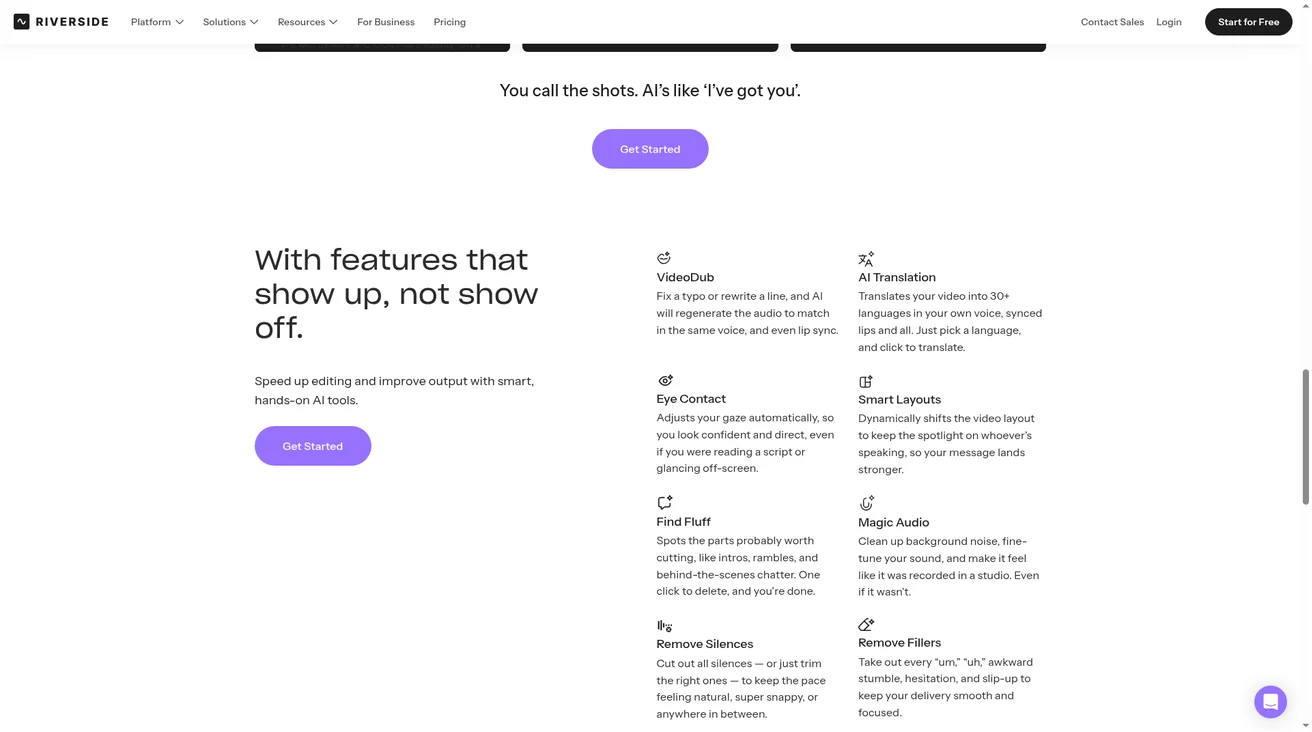
- Riverside offers gaze adjustment ("eye contact") in its editor on Pro ($24 per month billed yearly, $29 monthly) and higher plans. Riverside says it works only on tracks recorded in Riverside, not on screen shares or uploaded files, and can't be combined with its Enhance video effect.
- Windows Studio Effects is built into Windows 11 on PCs with a neural processing unit (NPU), and Microsoft designs it mainly for Copilot+ PCs. Its Eye contact effect works live on video calls. The Standard mode makes a subtle correction. The more natural Teleprompter mode is only available on Snapdragon Copilot+ PCs.
NVIDIA Eye Contact, Descript, Captions and BIGVU: Tool by Tool
Source: BIGVU, checked November 2026
NVIDIA Broadcast: best for live streams and calls on an RTX PC
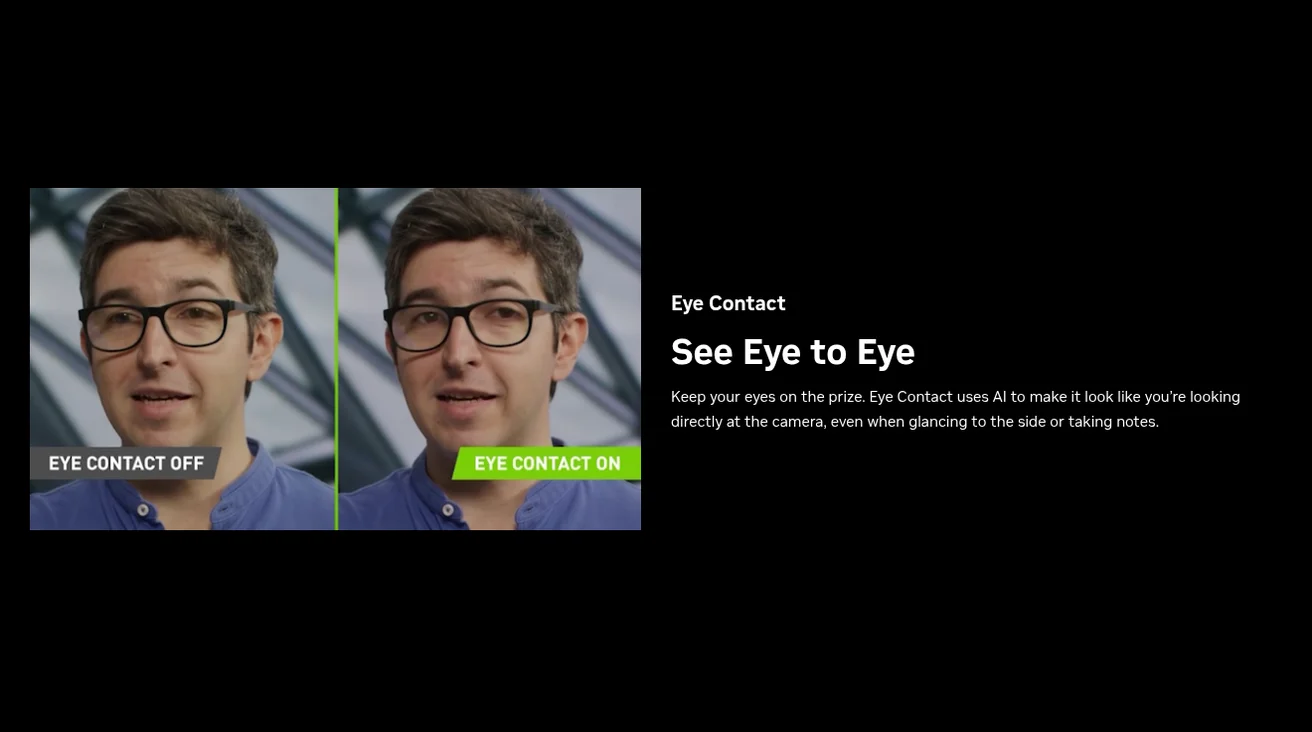
NVIDIA eye contact is part of the free NVIDIA Broadcast app. NVIDIA says the effect makes "it look like you're looking directly at the camera, even when glancing to the side or taking notes." It runs as a virtual camera, so you pick NVIDIA Broadcast as your camera in OBS, Zoom, Teams or any other app and the correction happens live.
- Requirements: Windows 10 or 11 (64 bit) or Windows 11 on Arm, an NVIDIA GeForce RTX 2060, Quadro RTX 3000, TITAN RTX, RTX Spark or higher, 8 GB of RAM and a recent NVIDIA driver. There is no Mac version.
- Price: NVIDIA calls Broadcast "free for all NVIDIA and GeForce RTX GPU owners."
- How natural it looks: Version 2.0 added "gaze stability and subtle random eye movements for a more natural appearance," according to NVIDIA's release notes. NVIDIA also built in a disconnect so the effect hands back to your real eyes "in case you look too far away."
- Recorded files: Broadcast 2.3.0 added a File Processor mode that applies "supported" effects to recorded .mp4 files offline. NVIDIA's release notes, FAQ and setup guide don't say whether Eye Contact is one of them, so treat Broadcast as a live tool.
Watch out for: NVIDIA's technical blog says redirection is most reliable "in a cone of around 20 degrees pitch and yaw angles." NVIDIA says it eases the eyes back to your real gaze in a short transition when you look outside that range. When XDA Developers reviewed the effect during its beta, they noted that if your eyes move too far to one side, "a snap-back to focus" can make the correction noticeable. NVIDIA has updated Eye Contact several times since then, so test it with your own setup.
Descript: best for editing podcasts and talking head videos
Descript says its Eye Contact effect "uses AI to redirect your gaze to the lens," so a take you recorded while reading notes away from the camera looks like you were talking straight to it. You apply it to a video layer in the editor, and it runs in the cloud, so you need to stay online.
- Price: Eye Contact uses AI credits. Hobbyist is $16 per person per month billed annually or $24 monthly (400 AI credits a month, 1080p export). Creator is $24 or $35 (800 credits, 4K export). Business is $50 or $65 (1,500 credits). The Free plan lists Eye Contact as "Limited": it draws on a one time pool of 100 AI credits shared with all of Descript's AI tools, with 60 media minutes a month and 720p export. Descript doesn't publish how many credits Eye Contact uses per minute.
- Descript's own tips: one clear face in the frame, a face that is "prominent and well lit," no "extreme side angles or full head turns," and a script kept close to the camera because "large offsets won't apply."
Watch out for: Descript says the effect "won't work on sideways footage," may not work with a variable frame rate (it suggests converting to a constant frame rate first) and may skip sections where you look far away or turn your head.
Captions: best for mobile creators already in the app
Captions says its feature "fixes your gaze after you record" and is "trained to detect common issues like looking at a script, glancing off to the side, and nervous blinks." In the mobile app it is a dedicated Eye Contact tool in the editing panel. On the web, Captions says you ask its text editor to correct eye contact for you. Captions' help article also shows the Eye Contact tool in its web editor.
- Price: Captions' help docs list Basic at $9.99 per month (200 credits) with Eye Contact. Max ($24.99, 500 credits) and Frontier ($69.99, 1,400 credits) include everything in Basic.
- Free plan: Captions has a free version, but Eye Contact isn't on its list of Free features.
- Captions' own tips: sit close enough that the camera sees your full eyes, and put your script slightly above or beside the camera.
BIGVU: best for scripted and teleprompter videos
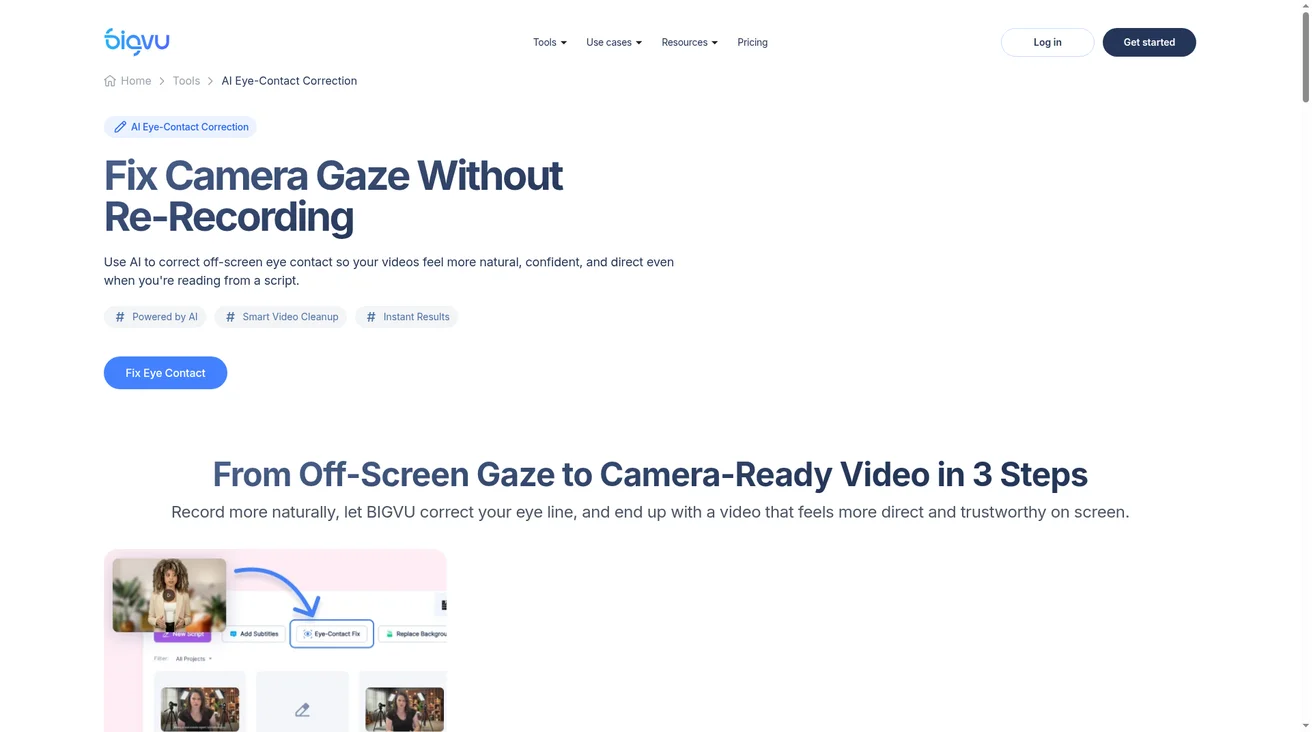
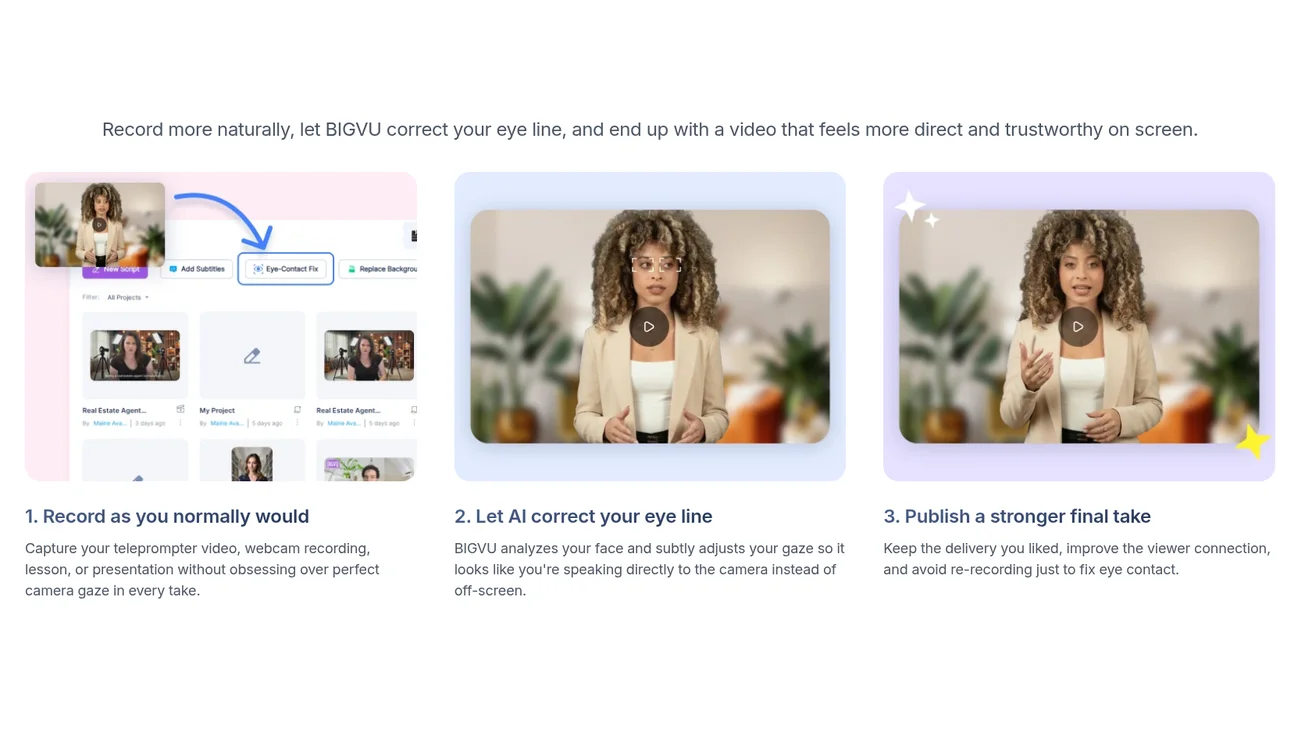
BIGVU built its AI Eye Contact Correction for people who read a script on camera. In BIGVU's words, it "analyzes your face and subtly adjusts your gaze so it looks like you're speaking directly to the camera." BIGVU pitches it as a way to fix camera gaze without recording again: you record as you normally would, then let the AI correct your eye line and keep the take you liked.
- How you use it on web: BIGVU's step by step tutorial shows two entry points. You can upload a fresh video from the Projects page, or open a project's Takes view and pick Eye Contact Auto Fix on an existing take. You then get a new take to play and compare with the original.
- Where it runs: AI Eye Contact Correction works the same way in the iOS app, the Android app and on the web.
- After recording only, and only when you ask: BIGVU does not correct eye contact live, and it doesn't run automatically on your teleprompter recordings. You click to apply it when you want it, and BIGVU keeps your original recording alongside the corrected version, so you can compare the two and keep whichever looks better.
- Where it fits: the same app includes BIGVU's Online Teleprompter and Mobile Teleprompter, the Webcam Recorder, the AI Subtitle Generator for captions, and publishing, so you can read your script near the lens while recording and fix the remaining glances in the same project.
- Price: eye contact correction is unlimited on the AI Pro and Max plans. On bigvu.tv/pricing, AI Pro is $19 per month billed annually ($229 per year) and lists "AI Eye Contact Fix + 4K export," and Max is $49. The Starter plan ($12 per month billed annually, $149 per year) does not include it, and neither does the Free plan. Super Agent ($239) includes everything in AI Pro.
- App stores: BIGVU Teleprompter Captions AI was the #1 App Store result for "ai eye contact" in the US, UK and Israel, and the #1 Google Play result in the US (checked November 2026; signed out search, and results change over time and vary by user).
Getting a good result: face the camera, keep your face evenly lit and clearly framed, and keep your script close to the lens. The smaller the gap between where you look and the lens, the more natural the correction looks. Then compare the corrected take with your original before you publish.
When Eye Contact Correction Looks Fake (and How to Use It Well)
Source: BIGVU, checked November 2026
Eye contact correction is useful, but it has limits, and the research is more mixed than the marketing.
What the research says
- Live correction can backfire in conversation. In a 2025 study presented at QoMEX, researchers ran a collaborative task with 32 participants and found that AI gaze correction "proved ineffective, leading to reduced perceived Naturalness of Eye Contact and increased Anxiety." The authors concluded that current implementations, "specifically the version in our study, are not yet suitable for enhancing conversational quality." The study looked at live calls, not edited videos (QoMEX 2025).
- Eye contact may matter less than you think. A CHI 2025 paper on video call interviews found that simulated eye contact (people deliberately looking at the camera) "had little impact on their evaluation compared to common belief," and noted that computational approaches to correcting gaze "can be deceptive" (CHI 2025).
- Dead center is not the goal. As covered earlier, the 2025 Journal of Vision study found looking just below the lens works better than staring straight into it.
Common signs the effect is struggling
- Your head turns well to the side, or you look far away from the camera. NVIDIA and Descript both say their tools switch off or skip these moments.
- The eyes "snap" back to the lens when the effect turns on again.
- Glare on glasses hides your eyes. Descript lists this as a cause of unnatural results.
- Your face is small in the frame or poorly lit.
- Two or more people are in the shot. Descript supports one person only.
How to get a natural result
- Fix the setup first. Script just under the lens, camera at eye level, face close and well lit. The smaller the offset, the more subtle the correction.
- Correct after recording when you can. For recorded content, a file based tool lets you compare before and after and keep the original if the corrected version looks off.
- Watch the whole clip. Check the moments where you turn your head or look away, since that is where most tools hand back to your real eyes.
- Use it with care in interviews and testimonials. Where viewers expect an unedited moment, a heavy correction can feel misleading. Keep it subtle, or skip it.
If you read scripts on camera, the simplest workflow is to record with a teleprompter close to the lens and fix the few glances that slip through afterwards. BIGVU AI Eye Contact Correction does this on the AI Pro and Max plans, and the tutorial shows how to run it on a take you already have. Your original take stays in the project next to the corrected one.