What brand consistency really means in personal branding
Consistency in personal branding is a promise about the experience, not the calendar. When someone meets your content, they should know within a second or two that it is yours, and they should get roughly what they got last time: the same level of care, the same point of view, the same kind of help.
It rests on three things.
- Visual consistency. The same colors, fonts, logo placement, captions and framing in every video. If a viewer sees your clip in a feed with the name hidden, they should still recognize it. This is where video branding does most of its work.
- Tonal consistency. Your voice, whether warm and chatty or calm and direct, should feel the same on Instagram, LinkedIn and YouTube. The format changes by platform. The person does not.
- Thematic consistency. A clear lane. Share your expertise, and mix in the human moments around it: a decision you made this week, a small win, a mistake you learned from. That blend of personal and professional is what turns followers into people who trust you.
Research is starting to draw the same line between showing up often and showing up the same way. A 2026 study in Telecommunications Policy of 47 beauty channels on YouTube in Korea found that upload frequency predicted engagement and revenue, while upload consistency strengthened audience loyalty. It is a small sample in one niche and one country, so treat it as a signal rather than a law. Still, the split is useful: frequency helps people find you, consistency helps them stay.

Intention or frequency? What the data actually says
A lot of personal branding advice says to post less and post better. The data is more complicated, and it is worth being honest about that.
Buffer, which sells a social scheduling tool, analyzed more than 2 million LinkedIn posts from 94,000 accounts. Moving from one post a week to two to five posts a week added more than a thousand impressions per post, and accounts posting more than 11 times a week saw the biggest lift. So frequency does matter for reach. Yet the same presenter warned that one consistent quality post per week is far better than seven rushed posts followed by silence, and that consistent posting beats short bursts.
Creators who have tested this on themselves often land in the same place. In one r/LinkedInTips thread, a member who posted daily for a year concluded that a lower, sustainable rhythm with better posts worked better than sheer volume.
The way to reconcile the two is simple. Pick the highest cadence you can keep up for a year without your quality dropping, then protect it. Give each post a job before you record it: attract new people, nurture the ones already following, or convert someone who has been on the fence. A few formats make this easier to repeat:
- Gentle authority posts that share what you have learned rather than telling people what they should do.
- Behind the scenes decisions that show how you work and make your audience feel like insiders.
- Small wins check ins that mark progress without waiting for a big milestone.
Choose two or three that feel natural and rotate them. Your audience gets variety, and you get a content strategy you can actually sustain.

Start with where your brand is going
It is hard to be consistent about something you have not defined. Brand strategist Caleb Ralston, who says he has spent 17 years building personal brands, makes this point in his video on building a personal brand: before you copy another format or hook, decide what outcome the brand is supposed to produce. If you start driving with no destination, you cannot pick a route, and you cannot tell whether you are getting closer.
For most people that outcome is concrete. More inbound clients. Speaking invitations. A job offer. Sales for a product. Once you name it, many choices make themselves. You know which topics belong in your lane, which platforms deserve your time and what every video should invite the viewer to do next.
It also helps to know that a clear identity usually arrives late. Dan Koe describes in his own story how he and a friend started a YouTube channel around 2016, made calisthenics videos and eating challenges that went nowhere, and later deleted them. His handle came from a summer job as a lifeguard. The coherent brand people know today came after years of experiments. If your early posts look scattered, that is normal. The goal is to tighten the thread from here on, not to pretend it was always there.
A useful exercise: write one sentence that says who you help, with what, and how you want them to feel after watching. Keep it next to your camera. If a video idea does not fit that sentence, save it for another day.

Build a repeatable system so consistency takes less effort
Knowing what consistency looks like is one thing. Keeping it up week after week is another. The answer is rarely more willpower. It is a system that removes small decisions from your week.
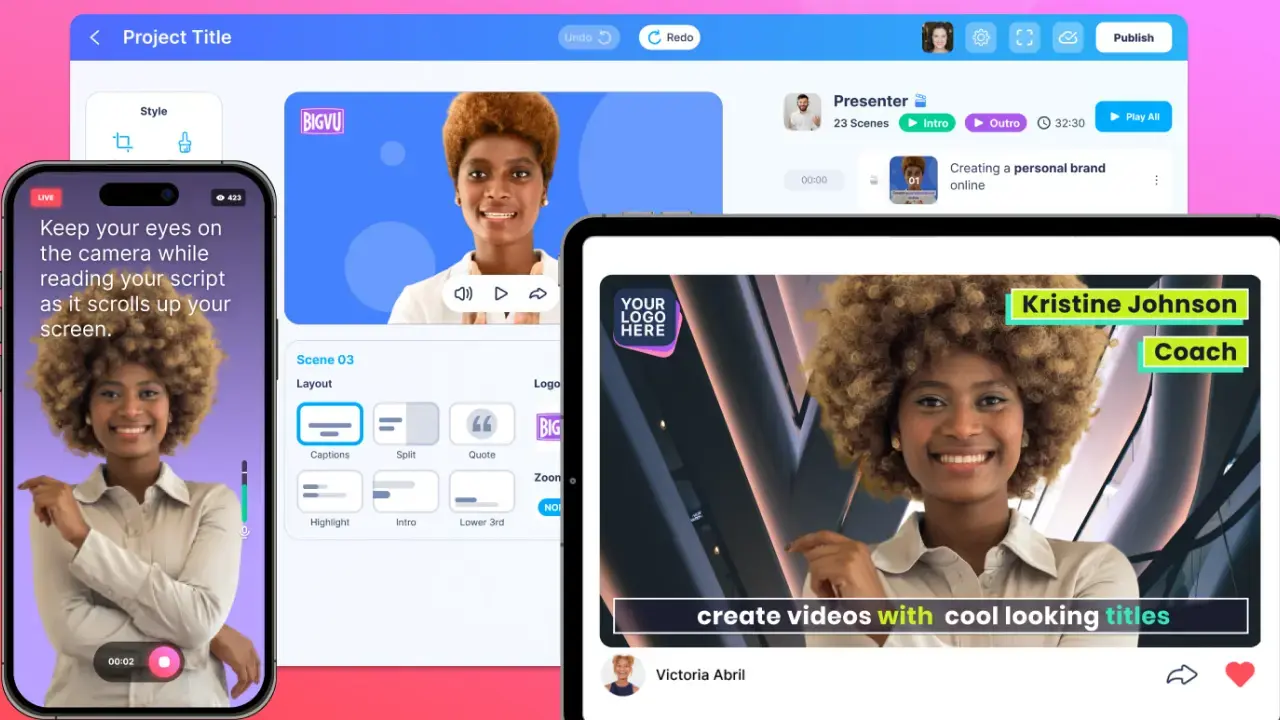
Lock in your brand kit once. Decide your colors, fonts, logo, captions style and outro, then store them where every new video can use them. The BIGVU Brand Kit works this way: you add your business details, logo, website, audience, messaging pillars and tone, then set creative defaults such as colors, fonts, avatars, voice clones, music, captions and outros. When you start a new video, those settings fill in automatically, so you are not hunting for hex codes before every shoot.
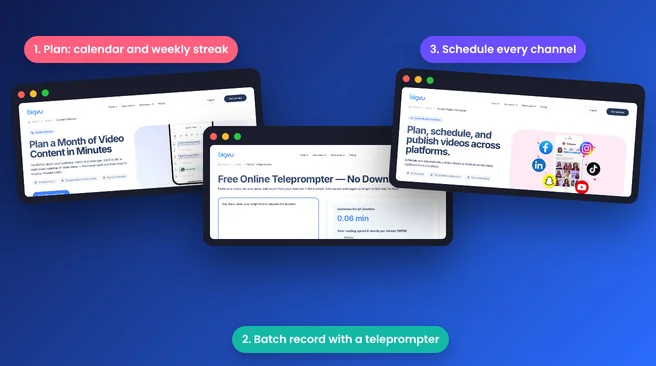
Plan the calendar before you need it. A blank page is where consistency dies. BIGVU’s Content Planner turns your posting frequency, tone, audience and pain points into a multi week calendar of video ideas with real dates. Each slot becomes a hook, then a script, then a recording, and a weekly streak and completion rate show you whether you are keeping your rhythm.
Batch your recording. Block one session to record three or four videos with different messages and the same look. Reading from a teleprompter keeps your delivery steady from one video to the next, and an AI script generator gives you a draft in your own voice to edit. Add subtitles and line everything up in a social media scheduler so the week runs without you.
Time box the work around each post. One r/personalbranding member described a routine that fits a busy schedule: about 20 minutes before posting and 20 minutes engaging after, on posting days only. It matters because replies are part of how people experience you. Buffer’s presenter also said replying to comments on your own LinkedIn posts can lift engagement by 30%, a vendor figure worth testing on your own account.
If you would rather hand the whole system to someone else, BIGVU SuperAgent is a done with you service: a content team plans, scripts, edits and publishes 8 videos a month in your brand kit, delivered weekly, for $299 a month billed monthly, with a lower price on yearly billing.
Why consistency builds trust, and how to sell without breaking it
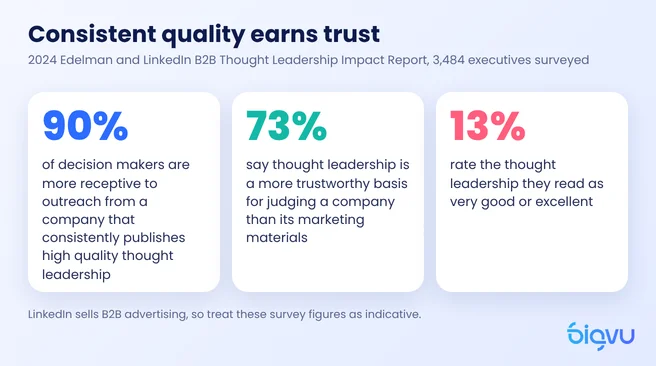
Consistency is not only about looking tidy. It changes how people judge you. In the 2024 Edelman and LinkedIn B2B Thought Leadership Impact Report, which surveyed 3,484 business executives, 90% of decision makers said they were moderately or very likely to be more receptive to outreach from a company that consistently produces high quality thought leadership. 73% said thought leadership is a more trustworthy basis for judging a company than its marketing materials. Only 13% rated the thought leadership they read as very good or excellent. LinkedIn sells B2B advertising, so read it with that in mind, but the message is clear: the bar is low, and steady quality stands out.
The fastest way to break that trust is to swing between helpful mode and hard sales mode. One week you teach, the next you shout about a discount, and the audience no longer knows which version of you will show up.
Storyselling avoids that jolt. Instead of a pitch, share a real story that leads naturally to what you offer: a problem you solved for a client, a lesson you learned the hard way, a before and after from your own work. The tone stays the same as your teaching content, and the call to action feels like the next step rather than an interruption.
Consistency does not require perfection. It needs a clear destination, a recognizable look and voice, a rhythm you can keep, and a system that makes it easy to show up as the same person every single time. Those are the video marketing tips that matter most.