Dan Koe: the idea carries the video, not the edit
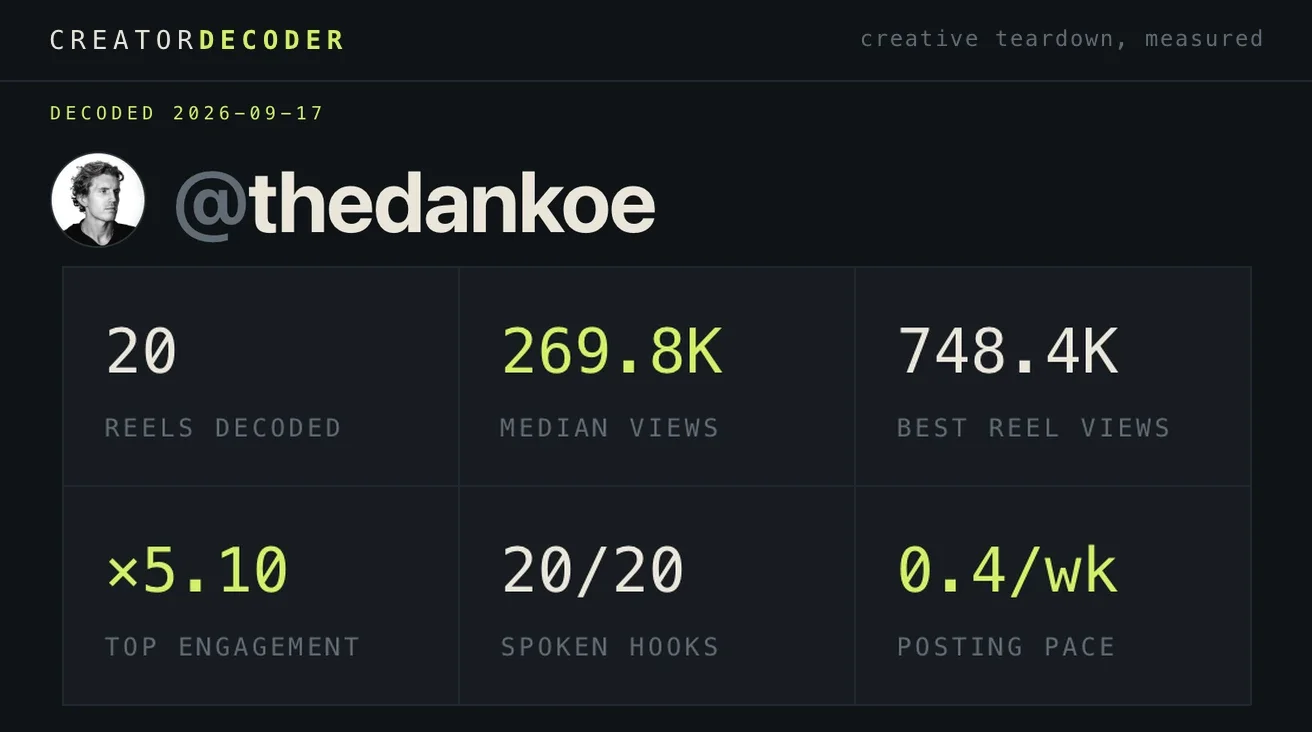
Dan Koe teaches one-person businesses. He posts a reel roughly every eleven days, and then sometimes goes quiet for two months.
His median reel does 269,800 views. That is the highest on this list, from the account that posts least.
What makes it interesting is how the videos are made. His median cut interval is 16.9 seconds, which in practice means most reels are one shot, or one shot with a single change. Creator Decoder's summary of his style is blunt: visuals are secondary, the focus is almost entirely on the spoken message. He is on camera in 19 of 20 reels, captions 18 of them, and does almost nothing else.
If you have read anything about short-form video in the last two years, this should not work. Cut every few seconds, the advice goes. Add motion. Add text. Keep the eye busy.
He does none of it, and his floor is the highest here. His top three reels account for only 34% of his total views, the lowest concentration of anyone we measured, which means the typical Koe reel is close to his best one. That is the opposite of a lucky hit.
The takeaway: if your content is an argument rather than a demonstration, editing will not save a weak idea, and a strong one does not need rescuing. Koe spends his effort before the camera turns on. One idea, phrased precisely enough to survive being said out loud without a single cut.
Nicole Walters: reach is not the same as audience size
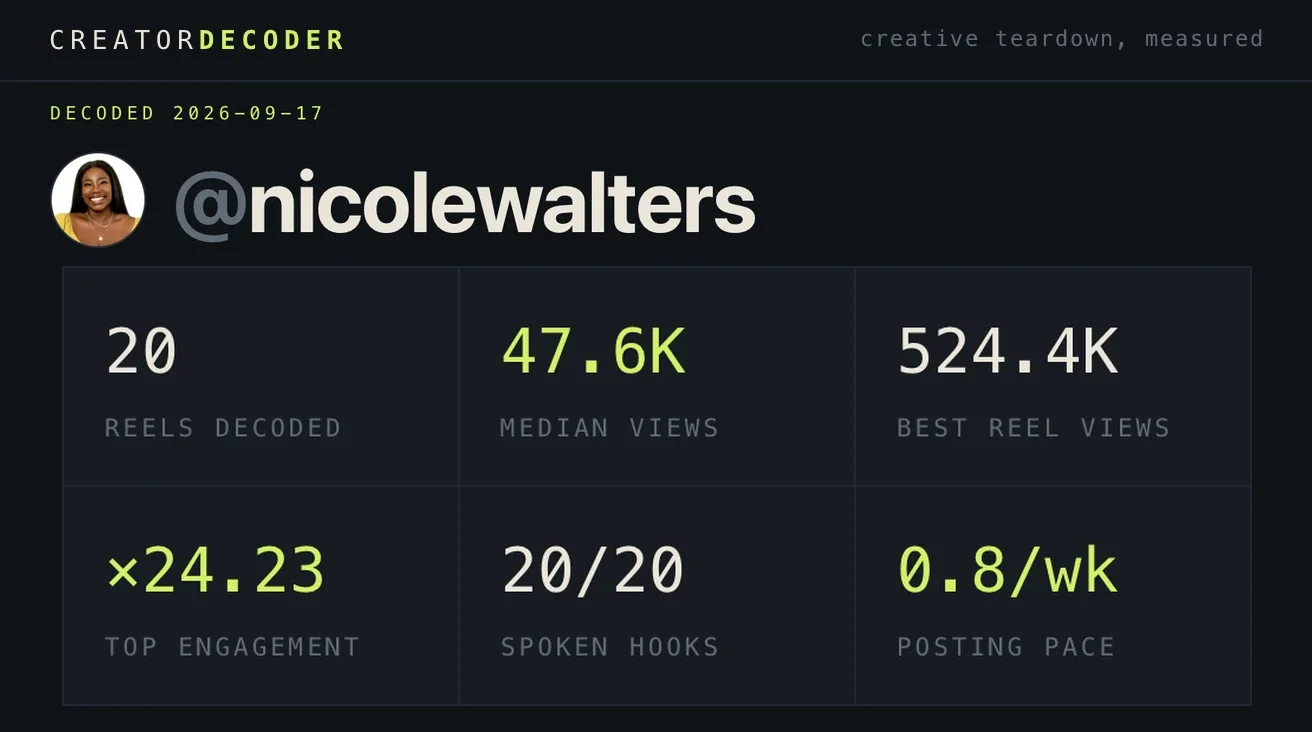
Nicole Walters is the smallest account on this list and the most efficient by a distance. Her median reel does 47,600 views against 262,000 followers. That is roughly 18% of her audience reached by a typical post.
For comparison, Codie Sanchez reaches about 1% of hers, and Leila Hormozi about half of one percent.
Walters posts 0.8 reels a week and is on camera in all twenty, with a spoken hook in every single one. No silent text cards, no faceless clips. Her cut interval sits at 9.9 seconds, in the middle of this group, and she varies it deliberately: long cuts when she is telling a story, fast cuts when she is making a claim.
The most useful detail in her report is about asking. Her calls to action work when they are immediate and concrete, like typing a word in the comments. They fall flat when they are abstract. Creator Decoder names the failing example directly: "Book your call" underperforms.
The takeaway: a small, engaged audience will out-reach a large, passive one, and the fastest way to waste the engaged one is to ask it for something vague. If you are going to interrupt a video with a request, make it something a viewer can do in the next four seconds without leaving the app.
Leila Hormozi: the format is right, the volume is not converting
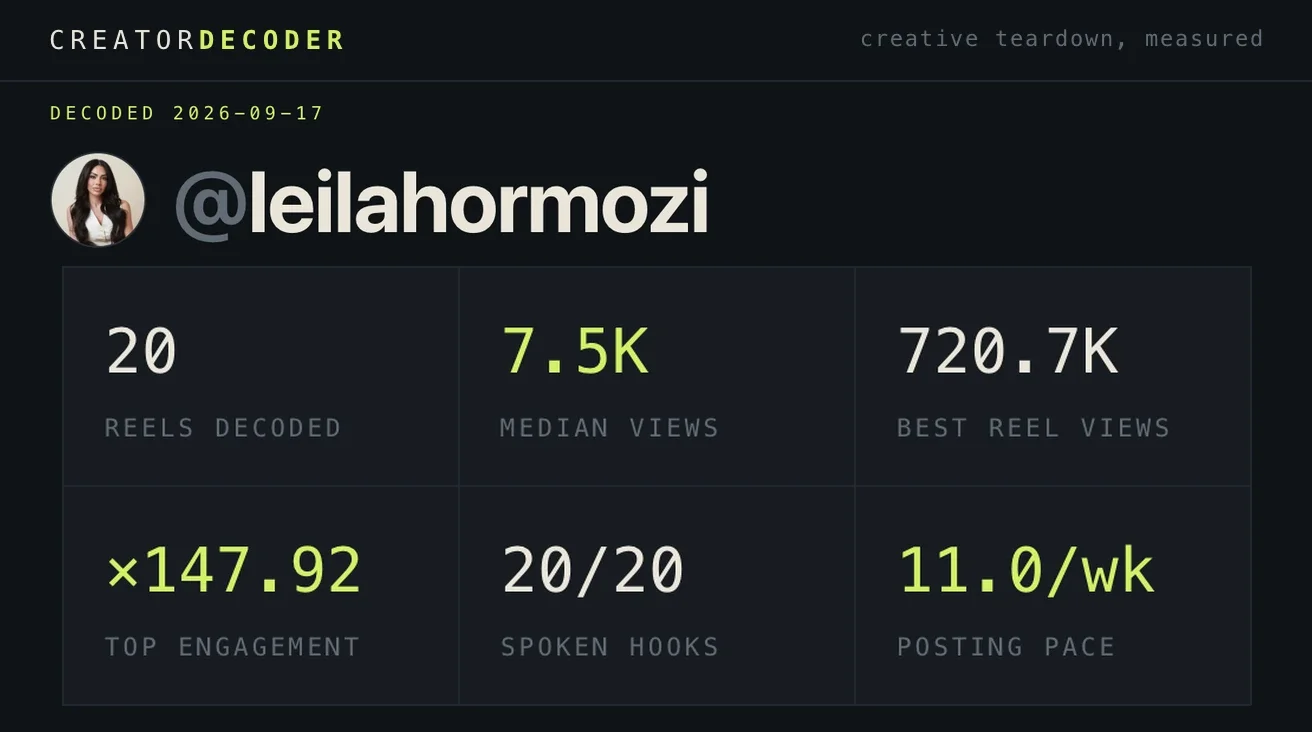
This is the hardest section to write, because Leila Hormozi is doing something genuinely instructive and her overall numbers do not show it.
She posts about eleven reels a week to 1.58 million followers. Her median reel does 7,500 views, the lowest on this list by a wide margin. But her best did 720,700, and her top three reels account for 73% of everything her account earned in the sample.
An account shaped like that is not really publishing. It is buying lottery tickets.
What is worth copying is what those winners look like. Eleven of her twenty reels are uncut or lightly edited talking-head monologues, and it is those, the ones with zero to two cuts, that dominate her top performers. Captions are absent from her highest-performing reels. Calls to action are absent from them too. Creator Decoder's line is that her highest-performing reels omit CTAs entirely.
So the thing working is the plain, unedited, direct-to-camera take. The thing not working is the eleven a week, most of which reach almost nobody.
The takeaway: publishing more does not raise your floor. If most of your posts reach a fraction of your audience, the answer is fewer and better, not faster. Look at what your own best three did, and ask why you are still making the other seventeen.
Dan Martell: what 59 reels a week actually buys
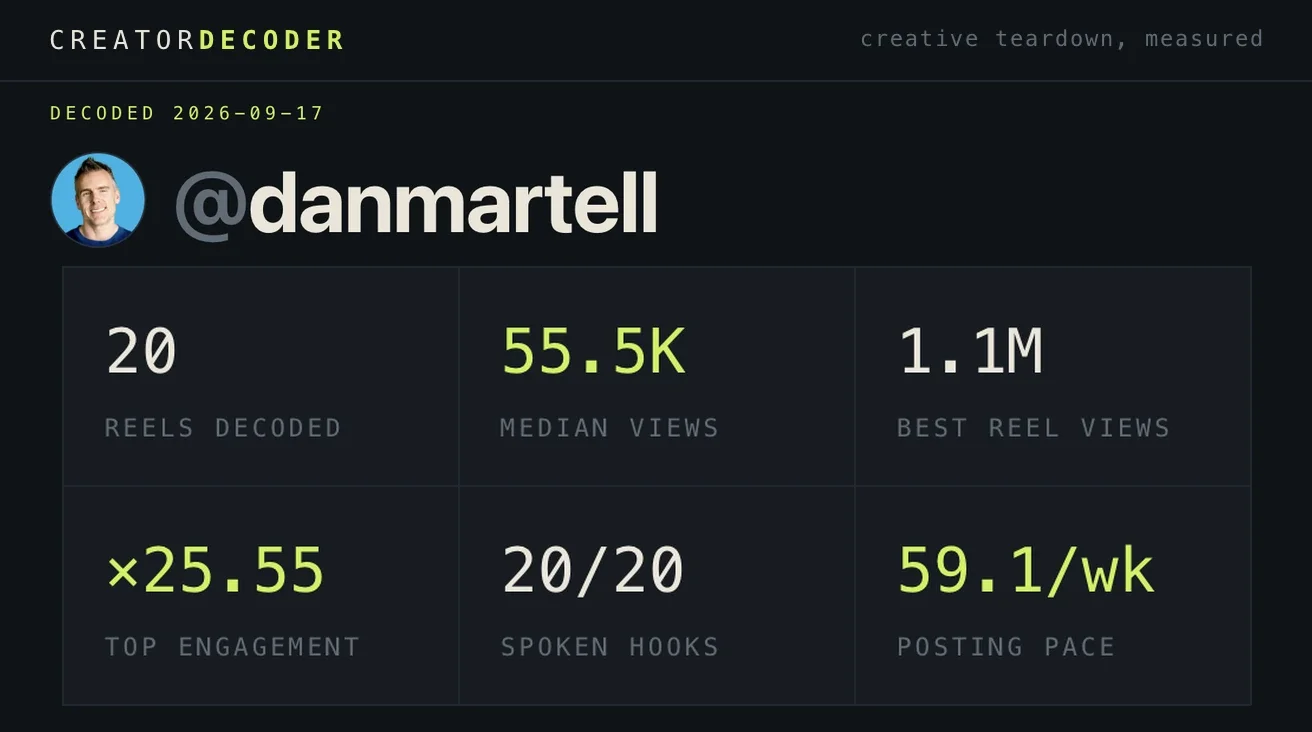
Dan Martell coaches SaaS founders, and he posts at a volume that is difficult to describe politely. Creator Decoder clocked him at 59.1 reels per week.
His median is 55,500 views against 3.07 million followers, or about 1.8%. His best reel did 1.1 million. And like Hormozi, his top three carry 73% of his total views.
His style is split down the middle: about 40% single-take monologues, about 50% fast-cut talking head at a cut every 2.5 to 6.5 seconds. The report's read on that split is the useful part. Single-take monologues are high risk and high reward, producing his 25x engagement outlier and several of his flops. The fast cuts do steadier work on instructional content.
Four in five of his reels have no call to action at all.
There is a real lesson in here, and it is not "post more." It is that his two formats do different jobs, and he appears to know which is which. The monologue is where he swings. The fast cut is where he teaches.
The takeaway: decide before you film whether a video is a swing or a service. A swing is one idea, one take, no safety net, and it either lands or it does not. A service video is structured, cut to keep pace, and reliably useful. Confusing the two produces videos that are neither.
Codie Sanchez: the one place the ask still earns its place
Across four of the five coaches here, the call to action is either missing or actively associated with worse performance. Codie Sanchez is the exception, and how she does it is worth stealing outright.
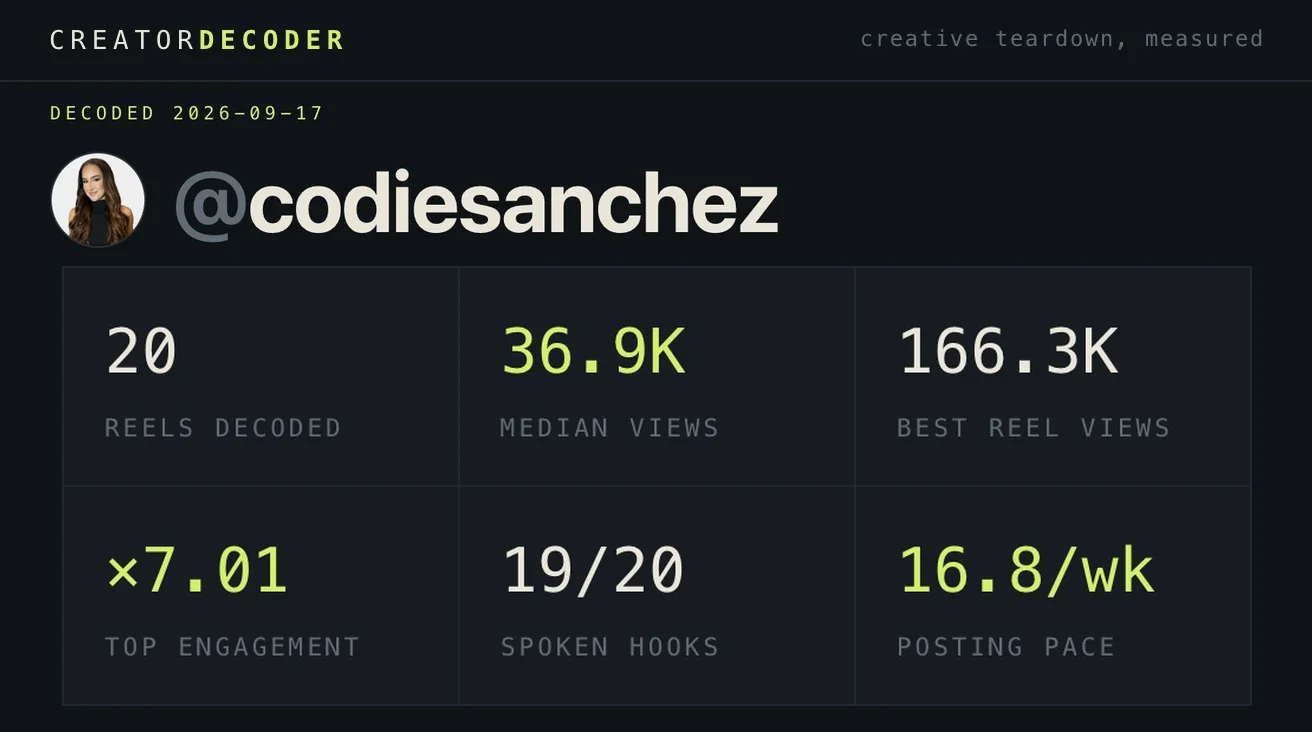
She teaches people to buy small businesses, posts 16.8 reels a week to 3.38 million followers, and medians 36,900 views. That ratio is thin, about 1%, and it is the weakest case on this list for her volume.
But her asks work. The pattern is a single trigger word, repeated across reels: comment OWN and I will send you the system. Creator Decoder's finding is that the CTA performs when the trigger word aligns with the brand lexicon and the reward is tangible. It is not "link in bio." It is one word, one thing you get, and the word is the same every time so the audience learns it.
Her editing is the fastest here, a 5.9 second median with nine of her top ten reels cutting under four seconds. Worth noting that fast cutting works for her and not for Koe, who is slower and reaches ten times the share of his audience. The difference is what the video is doing. Hers are myth-busting and list-driven. His are arguments.
The takeaway: if you are going to ask, own a word. One trigger, one promise, used consistently enough that your audience recognizes it. That is a system. "DM me" is not.