What ElevenLabs Is in 2026, and What Eleven v4 Changes
ElevenLabs started as a text to speech lab. In 2026 the same account covers text to speech, voice cloning, dubbing, speech to text, music, sound effects, Studio editing, and a separate Agents and API stack. Most creators still arrive for one job: turn a script into a voice that does not sound robotic.
The model lineup is the part older posts miss. ElevenLabs announced Eleven v4 and Eleven v4 Turbo on September 28, 2026, with "more than 90 languages" and a median inference latency of about 100 ms for Turbo. An official ElevenLabs YouTube explainer posted September 30 called v4 Turbo the model for real time voice agents, and said v4 covers "over 90 languages" with the biggest gains in Japanese, Brazilian Portuguese, Mandarin, and Cantonese. Professional Voice Clones that were trained on older models need a retrain for v4.
That does not erase Eleven v3. Independent reviewers still use v3 for expressive reads with inline tags like [whispers] or [laughs]. The practical split for 2026 is simple: use v4 when you want the current quality and language coverage, use v4 Turbo when latency matters, and keep Multilingual v2 for long, steady narration when consistency beats emotion.
Instant Voice Cloning starts on Starter. Professional Voice Cloning starts on Creator. Lukas Hüttis, who tested both after v4 launched and noted his video is "not sponsored; I pay for my subscription myself," put the gate in plain English in October 2026: "For an instant clone, Starter at $6 a month is enough; for a professional clone you need Creator at $22 a month." The Free plan has no cloning at all.

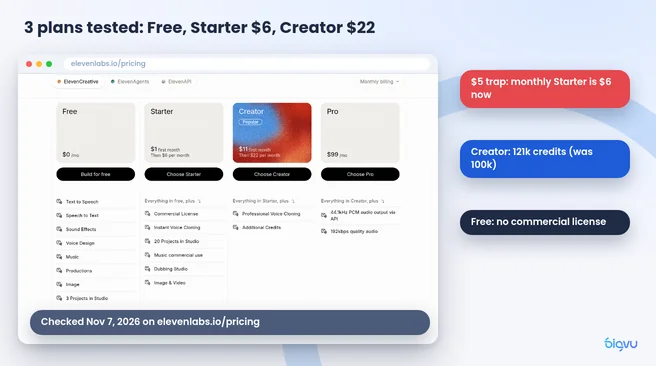
3 Plans Tested: Free, Starter, and Creator (and the Old $5 Trap)
We focused on the three plans most small creators actually compare. Prices below are from the ElevenLabs pricing page on November 7, 2026 (monthly billing unless noted). ElevenLabs sells the product, so check the live page before you buy.
| Plan | Monthly price | Credits | What matters for creators |
|---|---|---|---|
| Free | $0 | 10,000 | Core tools, no commercial license, no voice cloning |
| Starter | $6 (sometimes $1 first month) | 30,000 | Commercial license, Instant Voice Cloning, Dubbing Studio |
| Creator | $22 ($11 first month) | 121,000 | Professional Voice Cloning, buy more credits |
Pro ($99 / 600k credits), Scale ($299 / 1.8M, 3 seats), Business ($990 / 6M, 10 seats), and Enterprise sit above that. Annual billing is "two months free" (pay for 10 months), so Starter works out to $5 a month and Creator to about $18.33 a month if you pay yearly.
The $5 trap
Plenty of 2025 and early 2026 posts still list Starter at $5. The public monthly card is $6 now. The $5 figure only returns if you switch to yearly billing. Creator used to advertise 100,000 credits; it is 121,000 today. If you are budgeting from an old screenshot, your numbers are stale before you even open the credit FAQ.
What each plan is actually good for
- Free: try voices and Studio. Do not publish anything commercial. The Help Center rule is blunt: Free has no commercial license, and content made before or after a paid subscription still cannot be used commercially.
- Starter: the cheapest plan you can publish from. Instant cloning and about 30 minutes of plain text to speech a month if you spend the pool on narration only.
- Creator: where most solo channels land once they want a Professional Voice Clone and closer to two hours of narration a month.
First month promos come and go. When we checked, Starter showed a $1 first month banner and Creator showed $11 for the first month. Plan around the regular price, not the banner.
The Credit Trap: Why a Good Looking Plan Still Feels Expensive
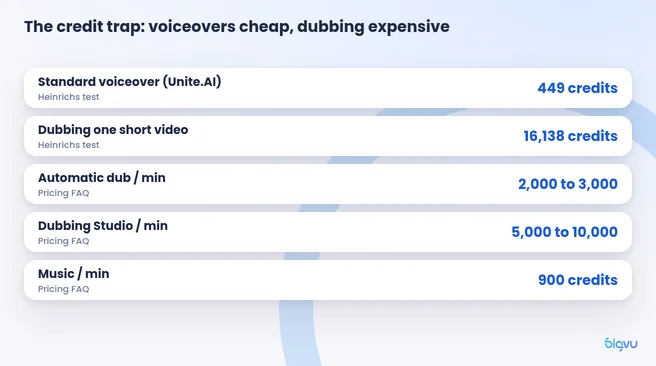
Every paid plan shares one monthly credit pool across every product. The pricing FAQ states the rates in public: Text to Speech is about 1 credit per character on Multilingual v2; Speech to Text is 330 credits per minute; Music is 900 per minute; Sound Effects are 200 per generation; Voice Changer and Voice Isolator are 1,000 per minute; Dubbing runs from 2,000 credits per minute (automatic with watermark) up to 10,000 in Dubbing Studio without a watermark.
That math is why plan cards mislead. Starter's 30,000 credits cover about 30 minutes of narration, or about 10 minutes of watermark free automatic dubbing, or only about 3 minutes of watermark free Dubbing Studio. Creator's 121,000 credits look huge until you spend them on music or multi language dubs.
Janine Heinrichs tested ElevenLabs for Unite.AI on September 21, 2026 (the page carries an affiliate disclosure). Her voiceover tests cost "449 credits each." Her dubbing test used "16,138 credits." Her summary of the downside is the line that stuck with us: "The main drawbacks are its shared credit system, inconsistent performance tags, expensive dubbing." She also wrote that "Standard voiceovers were relatively affordable at 449 credits each," which is the fair counterweight: if you mostly generate short narrations, Creator lasts a long time.
Do credits roll over?
Yes, on paid plans. Unused credits "roll over for up to two months, up to 2× your monthly quota," so the balance can reach at most three times the monthly allotment while the subscription stays active. Rollover does not apply on Free. Downgrading or cancelling forfeits unused credits at the end of the cycle. Upgrading carries unused credits into the next cycle.
The honest counterpoint
ElevenLabs is not "expensive" in every workflow. It is expensive when you treat the credit number as minutes of anything. Voiceovers are cheap relative to the pool. Dubbing, music, and regenerating lines because a performance tag was ignored are what empty the meter. If your month is mostly short English narration, Starter or Creator is fine. If your month is weekly videos into three languages, budget for Pro or for a different tool for the dub step.
Voice Cloning Quality, and What Is Better Than ElevenLabs
Quality is why people still start with ElevenLabs. Heinrichs found her Instant Voice Clone close enough for narration after a short clean sample. Hüttis ran a blind test after v4: in English, "the v4 instant clone from two minutes of audio came out on top three times"; in German, his Professional clone won. A 10 second clone was not his pick in any round. Instant can beat Professional in some languages after v4, but not as a blanket rule.
So what is better than ElevenLabs? It depends on the job.
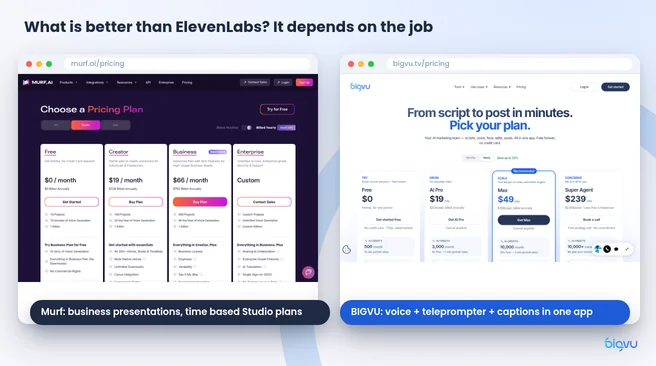
- Murf is the business voiceover alternative most reviewers name for presentations and training. On Murf's Studio pricing (checked via third party summaries of the live page in October 2026), Creator starts around $19 a month billed annually ($29 monthly) and Business around $66 a month billed annually ($99 monthly), with time based limits rather than a shared credit soup. Murf fits Canva and Google Slides workflows. It does not match ElevenLabs for expressive storytelling.
- OpenAI TTS / ChatGPT voice tools are fine when you already live inside that stack and need a quick read. They are not a full Studio, cloning, and dubbing suite.
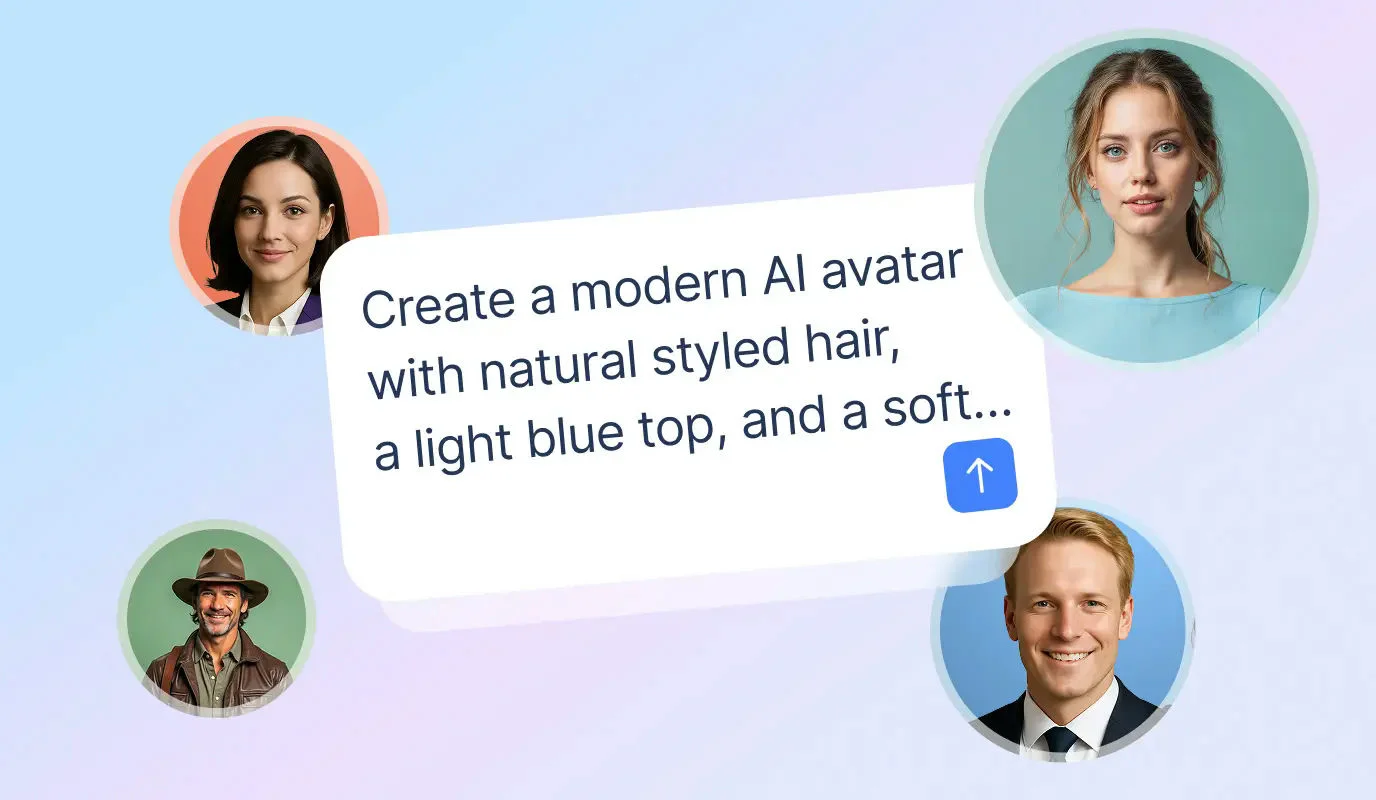
- BIGVU is the better pick when the deliverable is a talking head video, not a WAV file. You get scripts, a teleprompter, captions, editing, publishing, and AI voice design and cloning in one app. Free includes 500 AI credits a month with no card. On annual billing the BIGVU pricing page lists Starter at $12 a month, AI Pro at $19 with AI dubbing in 30+ languages, and Max at $49 ($589 a year) with an AI Twin of face and voice.
Which TTS tool is the best? For pure audio quality and expressive AI speech, ElevenLabs is still the benchmark most comparisons use. For corporate slide decks, Murf is often enough. For weekly video content of you on camera, an end to end video app beats bolting a separate voice tool onto a separate editor.
A Cheaper Workflow: When to Keep ElevenLabs, and When to Switch
Here is the split we would use after rechecking the numbers:
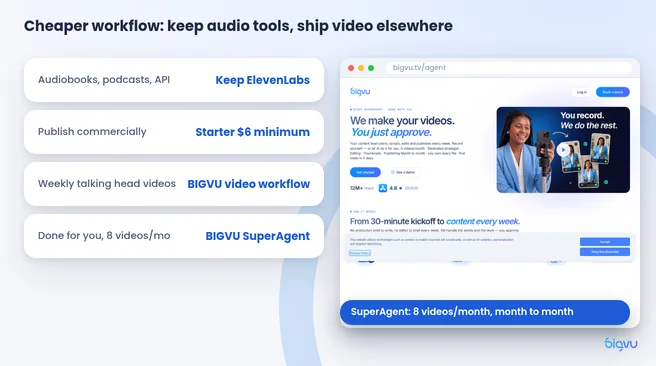
- Keep ElevenLabs for audiobooks, podcasts, game dialogue, API voices, and any project where the audio file is the product. Pay for Creator if you need Professional Voice Cloning. Jump to Pro when dubbing or API volume empties Creator mid month.
- Start on Starter, not Free, the moment you publish. The $6 commercial license is the real entry price. Free is a demo with a legal trap.
- Move the video workflow to BIGVU when you are filming (or cloning) yourself every week. Write the script, record with the online teleprompter or skip the camera with an AI Twin on Max, add captions, and publish without exporting audio from one tool into another.
If you want the whole pipeline handled for you, BIGVU SuperAgent is a done with you service: a dedicated strategist, scripts in your brand tone, editing with captions and thumbnails, and 8 videos a month published to your channels after you approve them. It is listed from $239 a month on annual Concierge billing and $299 a month billed monthly on SuperAgent, month to month, with the first video in 5 days. You keep every file. There is no money back guarantee claimed on that page, so do not expect one.
The short version of this ElevenLabs review: the voices are still excellent, Eleven v4 is the model to learn, and the $5 Starter figure in old posts is outdated. The plan that looks cheap on the pricing card can feel expensive once dubbing and regenerations hit the shared credit pool. Use ElevenLabs when audio quality is the bottleneck. Use BIGVU when shipping video every week is the bottleneck. Many teams will keep both.