
Where TikTok Privacy Settings Are in 2026 (and What to Do if the Menu Looks Different)
According to TikTok's help page on private and public accounts, the path is the same on iPhone and Android:
- Tap Profile at the bottom of the app.
- Tap the Menu ☰ button at the top.
- Tap Settings and privacy, then tap Privacy.
That one screen holds most of what people search for. TikTok's help pages point to it for the private account switch, Suggest your account to others, Activity status, Profile views, Direct messages, Comments, and Reuse of content (which controls Duet, Stitch, stickers and adding your posts to Stories). A third party walkthrough published on YouTube in September 2026 shows the same screen with Mentions and tags, Downloads, Following list, Liked videos and Post views as well.
Not everyone sees that layout. In a Reddit thread from around May 2026, a user wrote that the Privacy section had become "inaccessible" and that all they could find was "a useless webpage" instead. Other users asked how anyone was supposed to reach their privacy settings in 2026. TikTok has not explained the change publicly, so here is what we would try, in this order:
- Update the app. TikTok's own troubleshooting steps start with making sure you run the latest version.
- Check for Family Pairing. TikTok says that if a parent or guardian manages the account through Family Pairing, that can change which settings you can adjust yourself.
- Check your age setting. Some controls simply do not appear until you turn 16 or 18. Activity status, for example, is only available to users 18 and older.
Our advice is to treat any screenshot guide, including this one, as a map rather than a promise. The setting names have stayed fairly stable even when their position on the screen has not.
How to Hide Your Following List on TikTok (and Why Your Followers Are a Different Story)
This is the question that brings most people here, so here is exactly what you can hide and what you can't.
Who you follow. Go to Profile, Menu ☰, Settings and privacy, Privacy, then tap Following list and choose who can see it. Google's AI answer and recent tutorials describe the most restrictive choice as "Only you," while some older guides call it "Only me." TikTok's Help Center does not list the options for this control, so pick whichever choice on your screen limits the list to yourself. The change takes effect right away.
Who follows you. There is no separate switch for this on a public account. TikTok's help page is clear that on a public account anyone can "see your followers and following lists." The only way to hide your followers list is to make the whole account private. Then only people you approve can see it, along with your videos, LIVE videos, bio and likes.
What stays visible no matter what. In TikTok's words, "your name, username and profile photo will always be visible to anyone on or off TikTok," and other people can still search for your account. Going private hides your content. It does not make you invisible.
A small number of people find the Following list option missing entirely. One Reddit user described creating a new account, trying to hide the following list, and finding that "the option isn't showing up," even though it appeared on their older account. TikTok did not give a reason in that thread. If it happens to you, update the app and check again later. If you need the list hidden today, switching to a private account does the job.
If the goal is to keep one specific person from seeing your activity, hiding the list is a blunt tool. TikTok lets you remove a follower (Profile, Followers, the More actions button next to their name, Remove this follower) or block them, which we cover in the FAQ below.
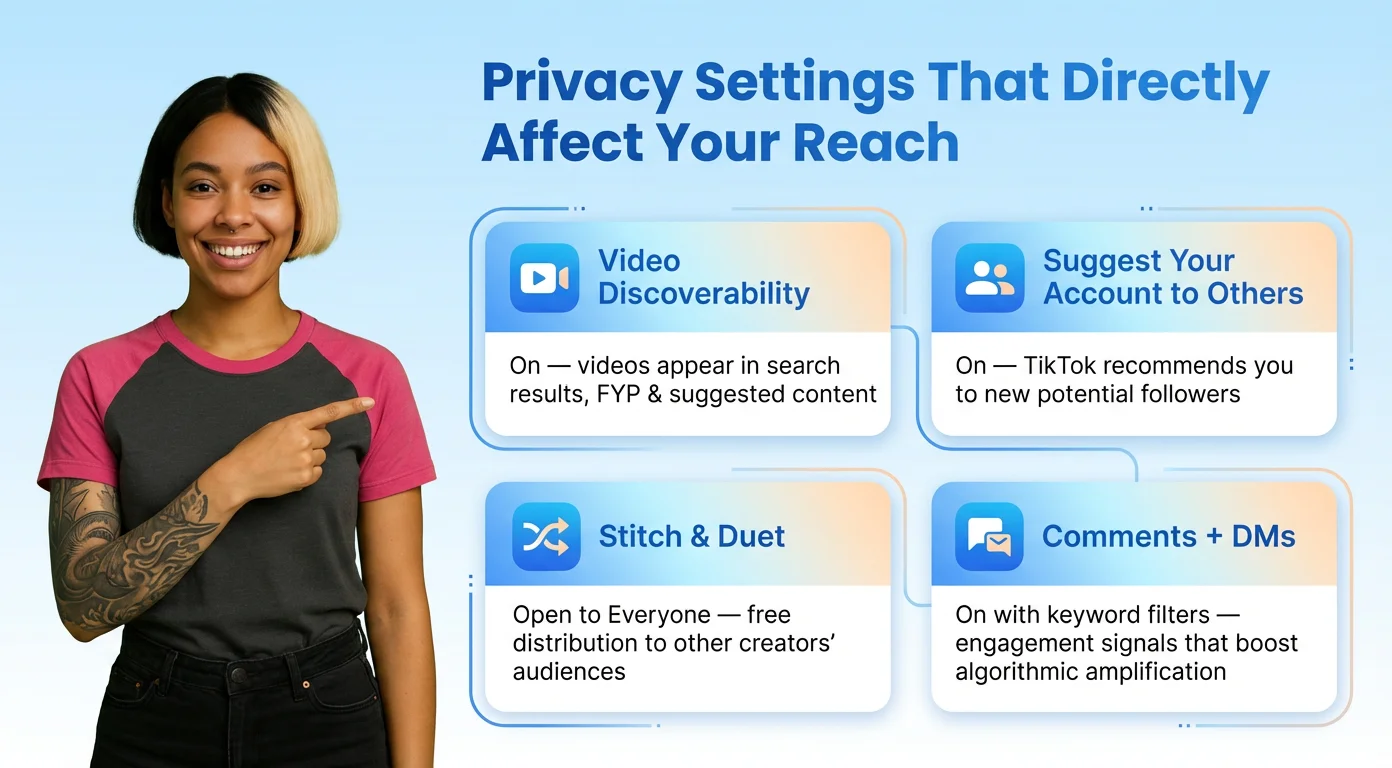
Private or Public: The Honest Trade Off, and the Settings in Between
Flipping the private account switch changes more than who can follow you. TikTok's help page lists what you give up: with a private account, people "won't be able to Duet, Stitch, create stickers with, or download your posts," and they can't add your posts to their Stories either. Every new follower has to be approved by you.
A public account works the other way. Anyone can follow you and watch your videos, and TikTok warns that your content "may appear in search engines, blogs, social media posts and news sites." For a coach, a realtor or a small brand, that reach is the point. For a personal account, it may be more exposure than you want.
You rarely have to choose all or nothing, though. These settings let a public account stay open without being wide open:
- Per post privacy. On a public account, each post can be set to Everyone, Friends (followers you follow back) or Only you. To change an old post, open it from your profile, tap More options, then Privacy settings. TikTok notes that the view count does not reset when you change it.
- Reuse of content. Under Privacy, this controls who can Duet, Stitch, make stickers from your posts or add them to their Story.
- Comments. Under Privacy, then Comments, you can filter keywords. Comments containing them stay hidden until you approve them.
- Suggest your account to others. This controls whether TikTok suggests you to your contacts, Facebook friends and people who open or send links to you. It is on by default for adults. TikTok adds that even with all of it off, you may still be suggested to people you follow, interact with or share connections with.
- Activity status and Profile views. Both are off by default. Profile view history only works if you are 16 or older and have fewer than 5,000 followers, and if you turn it on, others with it on can see that you visited them.
The idea that privacy should depend on the person is not new. When TikTok introduced age based privacy defaults for teens back in January 2021, Larry Magid, CEO of the online safety nonprofit ConnectSafely, said in a statement TikTok published: "When it comes to social media, one size does not fit all." That was five years ago and the details have changed since, but the principle still holds up well.
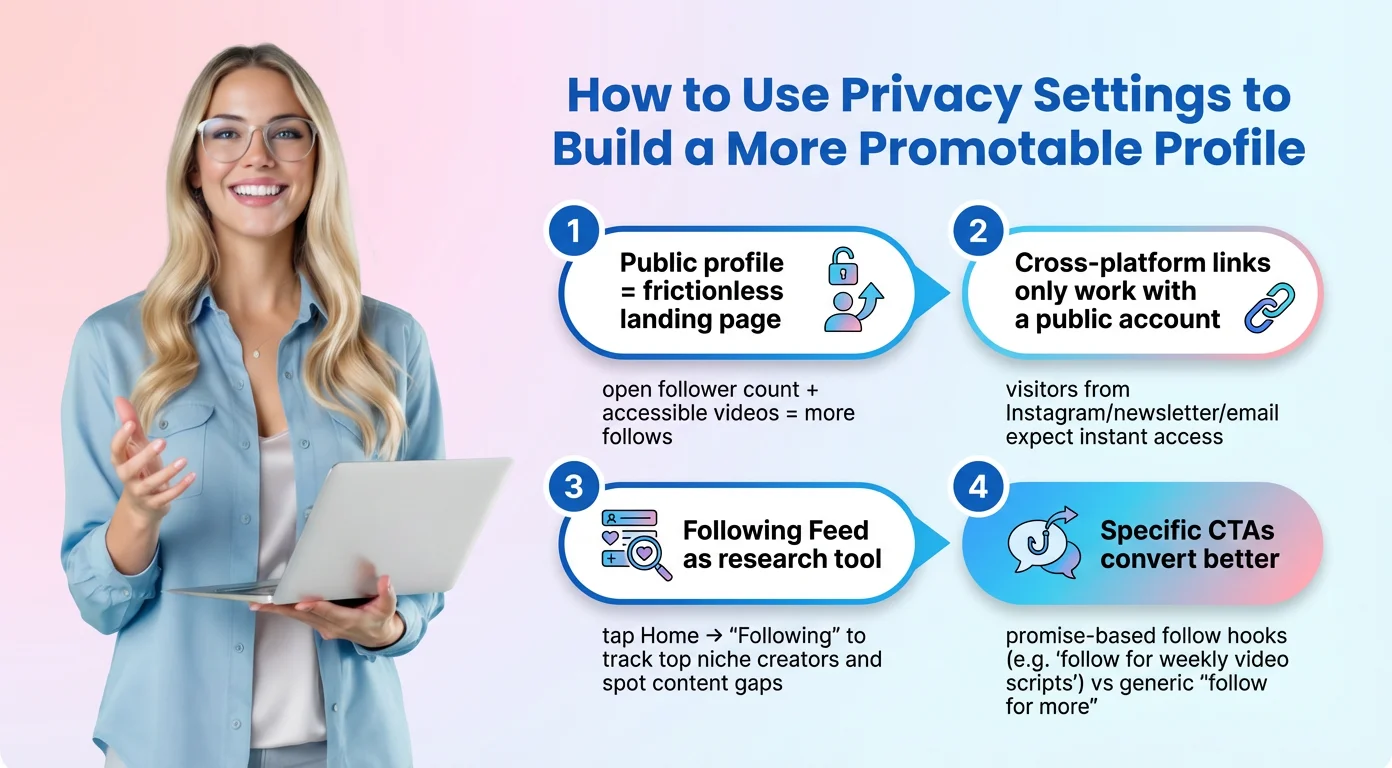
Teen Accounts: The Defaults TikTok Sets, and Where They Fall Short
Teens are the group for whom privacy settings matter most, and they spend real time on the app. In a Pew Research Center survey of 1,458 US teens published in December 2025, 61% said they use TikTok daily and 21% said they are on it "almost constantly," up from 16% in 2022.
TikTok's teen privacy page describes these defaults:
- Accounts for ages 13 to 15 and 16 to 17 are set to private when they sign up. Both groups can change this later.
- Direct messages are not available at all for ages 13 to 15.
- For ages 13 to 15, no one can Duet or Stitch their videos, video downloads are off, and comments are limited to Friends. None of these can be changed.
- Suggest your account to others is off by default for everyone under 18.
TikTok's Guardian's Guide adds that daily screen time "is set by default to 60 minutes" for teens and that content created by users under 16 is not eligible for the For You feed. In February 2026 the company said it now has "over 50 preset safety and privacy features" for teens. Some countries go further. In Brazil, Folha de S.Paulo reported that from March 17, 2026, accounts of users under 16 are private and can only be made public with a guardian's authorization.
All of that comes from TikTok itself, so here is the outside view. Common Sense Media's guide for parents, last updated August 4, 2026, confirms that TikTok "automatically sets accounts" of users aged 13 to 15 to private, and it recommends that families keep accounts private at first, revisiting the settings as a teen shows responsible behavior. That is a direct counterpoint to the advice you see in many growth guides, including the earlier version of this article: for a teenager, going public to chase followers is not the smart default.
Regulators are also skeptical that settings alone are enough. On February 6, 2026, the European Commission said it had preliminarily found TikTok in breach of the Digital Services Act over its addictive design, and wrote that "parental controls may not be effective because they require additional time and skills from parents." The Commission stressed that these findings "do not prejudge the outcome of the investigation." Still, the message is worth hearing: defaults help, but a conversation at home does more.
A final note for US readers. On January 23, 2026, TikTok announced that its US app is now run by the TikTok USDS Joint Venture, with ByteDance keeping 19.9%. That is TikTok's own description of the deal, and it changes who operates the service in the US. It does not change any of the switches described above.
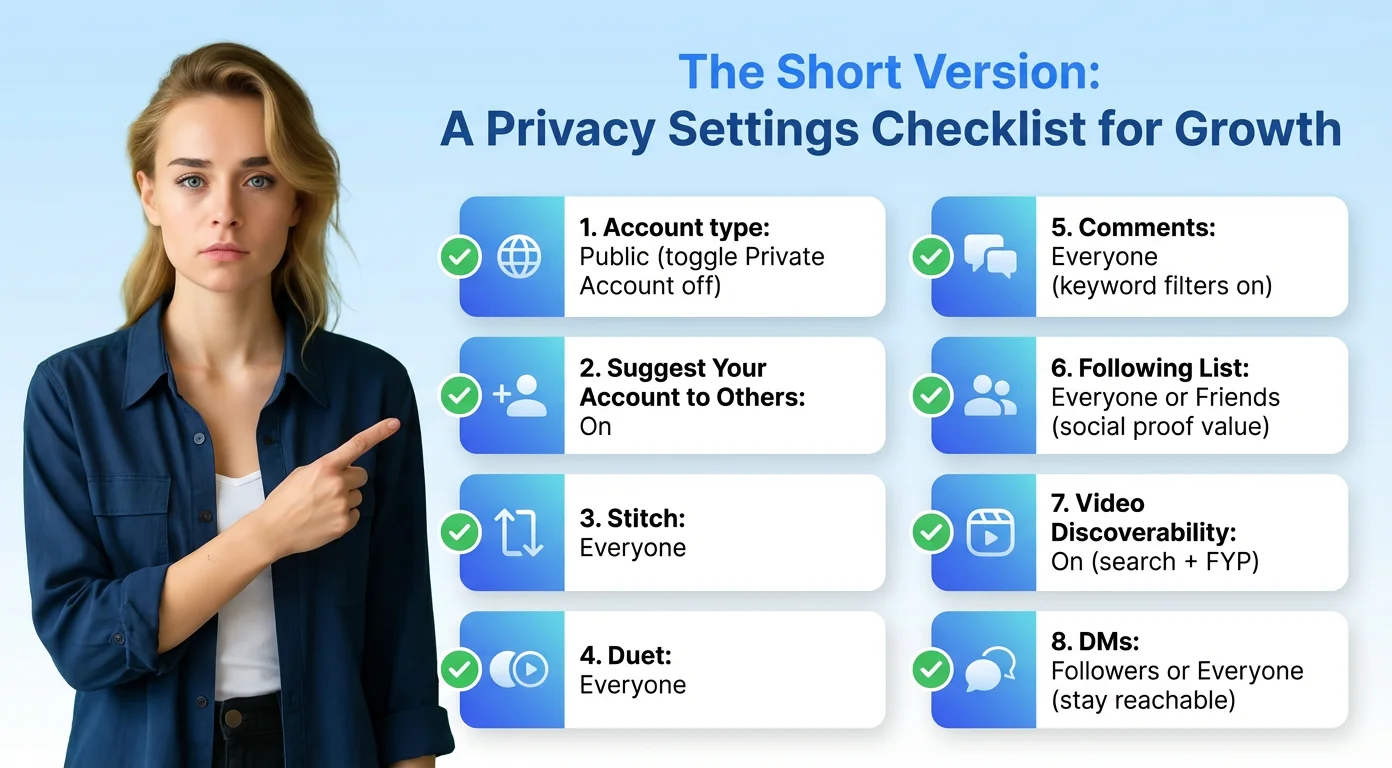
A Privacy Settings Checklist for Every Kind of Account
Here is how we would set things up, depending on who the account belongs to. Everything below is under Profile, Menu ☰, Settings and privacy, Privacy unless noted.
Creator or business account
- Private account: off. You want strangers to find you.
- Reuse of content: open to Everyone if you want Duets and Stitches to spread your videos.
- Comments: open, with keyword filters for spam and anything abusive.
- Following list: your call. Hiding it costs you very little.
- Per post privacy: use Only you for drafts, tests and anything time sensitive you want to pull later.
Personal account
- Private account: on, if the account is mainly for friends and family.
- Following list: limited to you, if you would rather not show who you follow.
- Suggest your account to others: turn off contacts and Facebook friends if you don't want to be found by people from your phone book.
- Activity status and Profile views: leave both off, which is the default.
Teen account
- Keep the private default, as Common Sense Media recommends.
- Set up Family Pairing together rather than in secret, and review the settings every few months as features open up at 16 and 18.
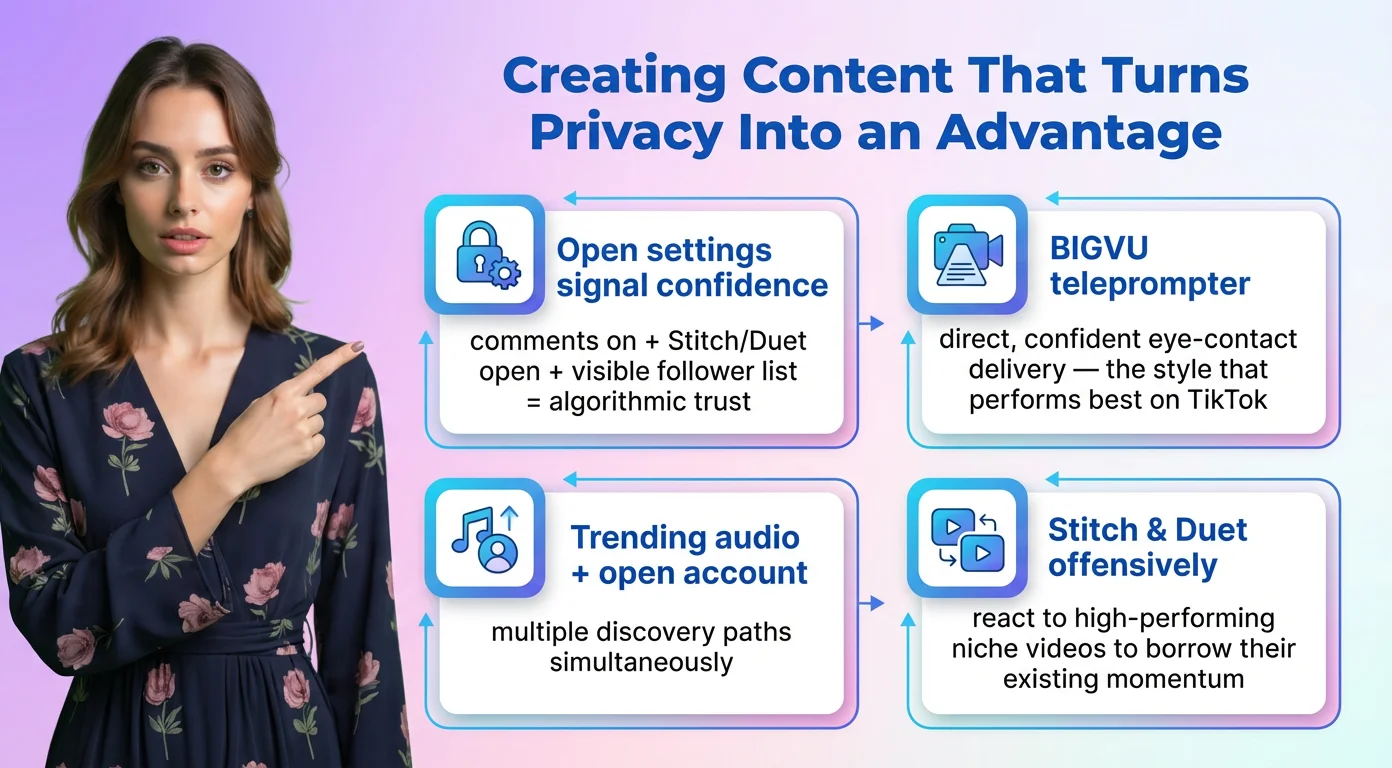
Once your settings are sorted, the thing that actually grows a public account is the videos themselves. Privacy switches decide who is allowed to see your work. They don't make anyone want to watch it. If you are on camera, the BIGVU teleprompter helps you deliver a script in one take while keeping eye contact with the lens. If you would rather not run the whole process yourself, BIGVU SuperAgent is a done with you service: a dedicated strategist plans and scripts your content, the team edits and publishes 8 videos a month, and you approve them. It costs $299 a month on the monthly plan, runs month to month, you own every file, and BIGVU says your first video arrives in 5 days.