
What Is an AI Voice Agent for Coaches?
An AI voice agent is software that answers your business phone the way a trained intake specialist would. It listens to what the caller wants, looks up the answer in your business information, and either books the call, captures the lead, or routes it to you. Modern versions sound natural enough that most prospects don't realize they're talking to AI — they just feel like they got through to a real person on the first ring.
Not the old phone menus your prospects hate
The old way was "Press 1 to learn about coaching, press 2 for billing." Nobody wants that, and warm leads especially don't want it — they've already decided you're worth a conversation, and a phone menu cuts the magic. An ai phone assistant skips the menu. A prospect can just say "I watched your reel on burnout and I want to know more about working with you" and the agent answers using your actual offer details, your typical client profile, and your calendar.
The four things every coach should expect from a voice agent
Dozens of tools sit in this category, but for a coach, four capabilities matter more than the rest:
- Pick up every call within two rings, including evenings and weekends. A surprising share of warm leads call outside normal hours — the moment they finish your podcast on a Sunday drive, the moment your launch email hits their inbox at 9pm.
- Answer using your real business information — your offers, your pricing structure (or your stance on not sharing pricing on a first call), your ideal client profile, your typical engagement length — not made-up facts that don't match your sales page.
- Take action during the call — book the discovery call into your calendar, capture name, situation, and the prospect's main goal, text them a link to your intake form, or transfer hot leads to your cell if you've flagged that.
- Hand off cleanly with a one-paragraph summary and full transcript, so when you walk into the discovery call you already know who you're talking to and what they want.
How it actually works on a typical discovery-call inquiry
Think of it like onboarding a brand-new intake VA on day one. You hand them a folder: your offers, your pricing approach, your client-fit criteria, your booking rules, the five questions you always ask on a discovery call. They read it. They sit by the phone.
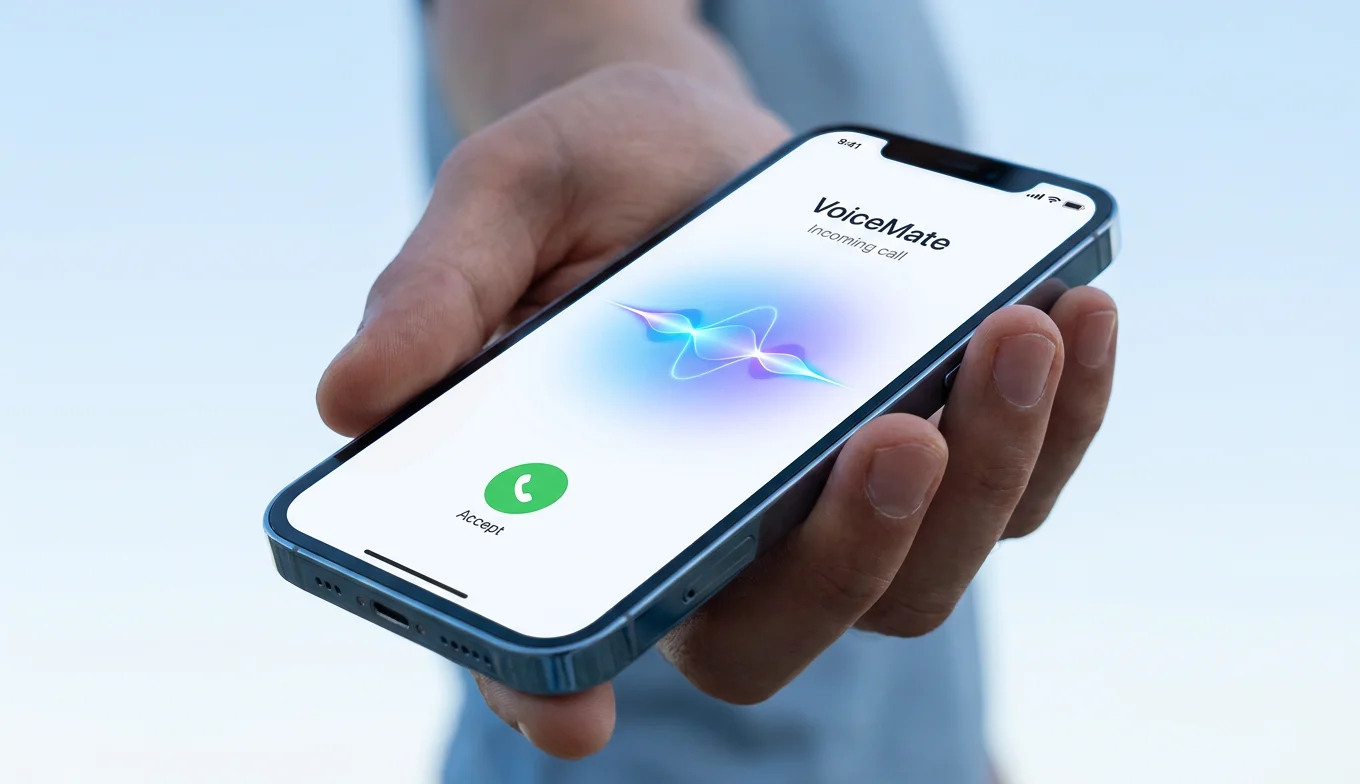
A prospect calls at 9:14pm after watching your podcast episode on the way home from work. The agent picks up in your voice, asks what brought them to reach out, walks through three qualifying questions (what they're working on, what they've tried, what timeline they're considering), and books a 30-minute discovery call for Thursday into your calendar. They send the prospect a confirmation text with your intake form and a short clip of your most relevant podcast episode. By the time you wake up, there's a brief in your inbox: "Burnout coach inquiry, recently promoted into senior leadership, has tried meditation apps, booked Thursday 11am." You walk into the call already knowing the story.
![[object Object]](/blog/images/airtable/section1-best-ai-voice-agents-coaches-2026.webp)
Where AI Voice Agents Actually Help Coaches
Generic AI-for-customer-service content treats voice agents like phone menus. For coaches, four use cases earn their keep — usually within the first month of the tool paying for itself.
Discovery-call inquiries that come in at the worst times
Prospects don't call when it's convenient for you. They call after watching your latest reel at 10pm. They call between their own meetings. They call on Sunday afternoon after binge-watching your YouTube channel. An ai phone receptionist keeps the conversation alive when you're not available: it confirms what you do, asks the qualifying questions you'd ask (current situation, budget signals, timeline), books the discovery call onto your calendar, and texts the prospect a link to your intake form so they show up prepared.
Lead qualification before the call gets to you
Not every caller is a fit, and coaching time spent on bad-fit calls is expensive. A good voice agent runs the first five minutes of the conversation: confirms what kind of help they're looking for, surfaces the basics of their situation, and either books a call (good fit) or sends them to your free resources (not a fit yet, but warm). You walk into the discovery call already knowing this person is the right kind of client, and you have a quick brief in your inbox: their goal, their stumbling block, what made them reach out.
Session reminders and reschedules without the back-and-forth
No-shows and last-minute reschedules drain a coaching practice. AI voice agents can call clients 24 hours before a session to confirm, send a follow-up text if they don't answer, and handle reschedule requests on the spot — checking your calendar, offering the next three open slots, and rebooking with one back-and-forth instead of five.
Following up with launch attendees and webinar no-shows
This is where outbound shines (Retell, Synthflow). After a launch, you have a list of people who watched the workshop but didn't book. After a free webinar, you have replays, no-shows, and lurkers. An AI agent can dial through a segmented list with your personalized script, ask if they have questions, and book whoever's interested onto a real call. It's the kind of high-volume, low-energy follow-up that human assistants burn out on by week three.
![[object Object]](/blog/images/airtable/section2-best-ai-voice-agents-coaches-2026.webp)
6 Best AI Voice Agents for Coaches Compared
These six tools were chosen for the things a coach actually needs: a voice that doesn't break the trust you've built online, smart enough to qualify a lead instead of just taking a message, fast to set up between client sessions, and priced for a solo or small-team business.
BIGVU VoiceMate — Best for coaches whose brand lives on social media
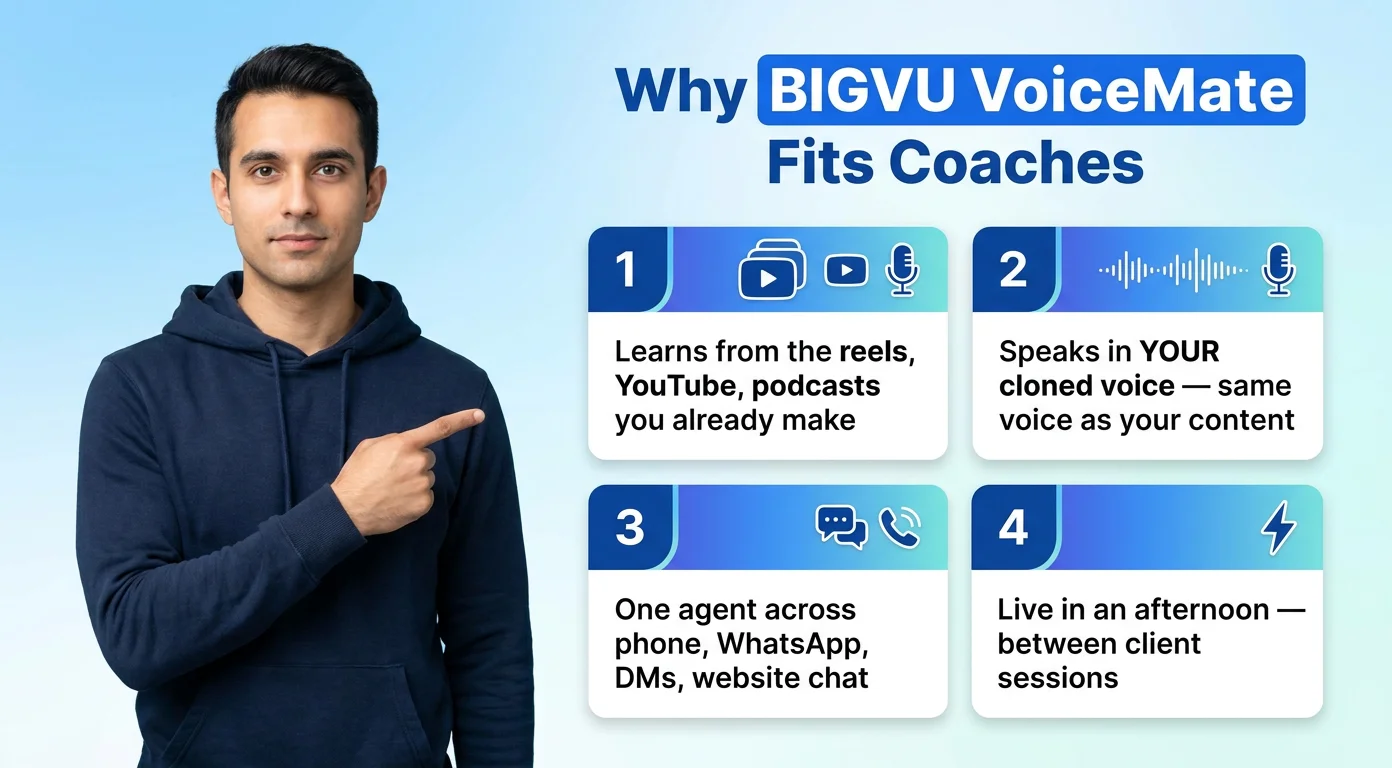
Most coaches already invest hours into Instagram reels, YouTube videos, podcast episodes, or LinkedIn posts. BIGVU's voice agent is the only tool on this list that learns about your business from all of that — not just a stale About page. The agent answers a discovery call using the same offer language, pricing framing, and client-fit criteria you've already shared in your content, so the call feels like a continuation of what the prospect has been watching.
The voice-clone feature is the real differentiator. BIGVU records a short sample, then speaks in your voice on every call. For a coach whose audience knows the sound of your voice from your reels, that's a level of brand consistency no other tool on this list offers.
VoiceMate also handles WhatsApp, Instagram DMs, and your website chat with the same agent and the same booking logic. Live in an afternoon, no developers required.
Best for: solo coaches and small coaching businesses where your personal brand is the engine of new clients.
Lindy — Best for coaches with a built-out tech stack
Lindy connects to thousands of apps, so it fits coaches running a real ops stack: HubSpot or Kajabi for CRM, Calendly or Acuity for booking, Zapier glueing it together, Stripe handling payments. It can answer a call, qualify the lead, push them into your CRM with the right tags, book the discovery call, and email you a summary with a recommended next step. Starts around $50 a month.
The trade-off is setup. Lindy gives you the Lego pieces and expects you to assemble them. Expect to spend several evenings tuning it before you trust it with leads from your launch.
Best for: coaches with a developed funnel and tools who want one agent that ties calls into their existing systems.
Synthflow — Best for coaches running launches or large programs
Synthflow bundles the voice, phone number, and conversation logic into one monthly subscription. The visual builder lets you map out exactly how a discovery call should go vs a returning-client call vs an inquiry about your free workshop — useful for coaches running multiple offers or launches.
The catch is price. The starter Pro plan runs about $375 a month, which is overkill for a coach taking 30 calls a month but makes sense for one running a launch with hundreds of inbound inquiries in a week.
Best for: coaches running launches, group programs, or scaled businesses with high inbound call volume.
Retell AI — Best for outbound follow-up campaigns
Retell charges by the minute — about 7 cents per minute, with no monthly fee. New accounts get $10 of free credits. The voice quality is genuinely strong, and Retell is excellent at outbound, which is rare in this category. For coaches who want to follow up with old leads, no-shows, or warm-but-cold contacts from a webinar, Retell can dial through a list with a personalized script.
The catch is that Retell expects you to wire some pieces together yourself — phone number provider, AI logic, CRM. Not hard for tech-comfortable coaches, but not turnkey either.
Best for: coaches running outbound campaigns, or coaches whose call volume swings hard month to month based on launches.
Rosie — Best for solo coaches who want the simplest possible setup
Rosie is the easiest tool on this list to set up. It reads your website and Google Business profile, learns your business in a few minutes, and is built for solo operators who can't answer the phone while working. Plans start at $49 a month with a 7-day free trial.
The voice is warm and natural, which matters for coaches. The limitation is depth: Rosie is a smart message-taker that handles common questions and books appointments. It doesn't pull from your social content, it can't clone your voice, and it doesn't branch into the longer qualification conversations that high-ticket coaching often needs.
Best for: lower-ticket coaches or coaches just getting started, where the priority is "never miss a call" rather than deep qualification.
Goodcall — Best for coaches with workshops, retreats, or recurring offers
Goodcall lets you map out exactly how different kinds of calls should be handled — different times of day, different offers, different next steps. Starter plan is $59 a month for up to 100 unique callers.
It fits coaches running offers with predictable questions: workshops ("When is the next one?" "What's included?"), retreats ("Where is it?" "How do I pay?"), and group programs with cohort-based intake. The downsides: pricing climbs once you cross 100 unique callers, and the voice sounds noticeably less natural than the newer tools.
Best for: coaches with structured offers and predictable inquiry patterns.
Quick comparison for busy coaches
BIGVU VoiceMate — Low price — Calls + WhatsApp + DMs + website chat — Learns from social, copies your voice — Coaches whose brand lives on social media
Lindy — ~$50/month — Calls + chat — Deep CRM and app integration — Coaches with built-out tech stacks
Synthflow — ~$375+/month — Calls only — Visual builder, multilingual, one bill — Coaches running launches or large programs
Retell AI — 7¢/minute, no subscription — Calls (inbound + outbound) — Pay only for what you use — Outbound follow-up, variable volume
Rosie — $49/month and up — Calls only — Easiest setup, warm voice — Solo coaches, lower-ticket, message-taking
Goodcall — $59/month and up — Calls only — Detailed call routing rules — Coaches with workshops/retreats/recurring offers
![[object Object]](/blog/images/airtable/section3-best-ai-voice-agents-coaches-2026.webp)
Why BIGVU VoiceMate Fits Coaches Specifically
Most voice agent tools were built for restaurants and home services. They answer calls fine, but the pieces that matter to coaches — sounding like you, handling the trust conversation, knowing your offer — aren't really in the design. BIGVU VoiceMate was built with coaches and personal-brand businesses in mind. Three things make the difference.
It learns from the content you've already created
Other tools read your website. If your sales page is rich and current, that's fine. For most coaches it isn't — the real story of your work lives in your Instagram captions, your YouTube long-forms, your LinkedIn posts, your podcast episodes. BIGVU pulls from all of it, plus your website and any documents you upload (your offer sheet, your common objections doc, your client onboarding guide). When a caller asks "How is your group program different from the 1-on-1?" the agent answers using the same comparison you've already given in three different reels.
Callers hear your voice, not a stock voice
This is the differentiator that matters most for coaches. Your prospects pick you because of who you are — your tone, your warmth, your way of framing things. A stock "professional female voice" on the call breaks that connection in the first ten seconds. BIGVU clones your voice from a short recording. The lead who watched your Sunday reel hears the same voice on Tuesday's discovery-call inquiry. Same pacing, same warmth, same delivery. For a business built on trust, that's a different category of tool than every other option on this list.
One agent for phone, WhatsApp, DMs, and website chat
Different leads come through different channels. An Instagram follower DMs. A podcast listener calls. A LinkedIn connection messages on WhatsApp. A cold visitor lands on your website. BIGVU runs the same agent across all of those — same voice, same offer knowledge, same booking logic. For a solo coach, that's one tool instead of four, and one set of conversations in one place.
Live in an afternoon, not a project
Some tools in this space (Vapi, Retell at the deeper end) sell the parts — the AI brain, the voice, the phone number — and expect you to wire them together. That works if you have a tech-savvy ops person. For a coach trying to do this between two client calls, it's an obstacle. BIGVU is the assembled product: paste in your Instagram and YouTube links, upload your offer doc, pick a voice (or clone yours), connect your calendar, embed on your website. You can set up your ai virtual receptionist between sessions and have it capturing leads the same evening.
How to Choose the Right AI Voice Agent for Your Coaching Business
There's no single best tool for every coach. The right fit depends on your offers, your tech comfort level, and how much of your business comes from inbound vs outbound. Here's how to narrow it down in five minutes.
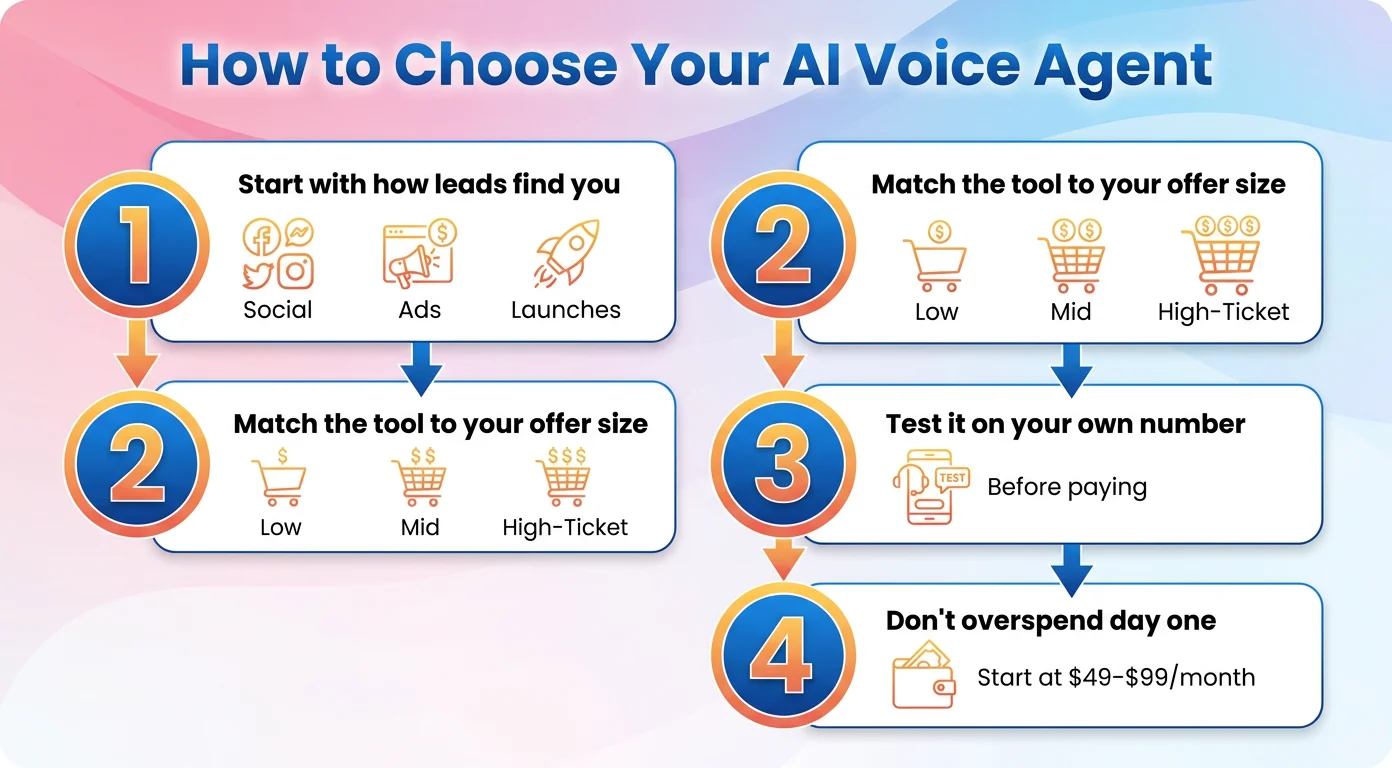
Start with how leads find you
If most of your business comes from social media (reels, podcast, LinkedIn, YouTube) and your warm leads call after consuming a lot of your content, you need a tool that knows the coach they've been watching — BIGVU VoiceMate is built for that. If you generate leads through paid ads or a structured webinar funnel and the bottleneck is response speed, look at Lindy or Retell for CRM integration. If you primarily run launches and need to handle a spike of calls during a launch week, look at Synthflow.
Match the tool to your offer size
Low-ticket coaches ($500-$1,500 per client) or coaches just getting started: Rosie or BIGVU VoiceMate on the starter plan. The math is simple — capture one extra client a month and the tool pays for the year. Mid-ticket ($2,000-$5,000): BIGVU, Lindy, or Goodcall, depending on tech comfort. High-ticket ($5,000+) or premium 1-on-1 coaches: BIGVU for the voice authenticity, or Lindy for the deeper qualification logic before a high-ticket call gets to you.
Test it on your own number before paying
Every tool on this list offers a free trial or free credits. Pick one, spend an hour setting it up with your actual offer information, then call your own number from your cell. Ask the hardest question a tough prospect has ever asked you: "Why are you worth $X?" or "What makes you different from [bigger-name coach in your niche]?" If the agent falls apart, it'll fall apart with real leads. If it sounds like you and handles the question well, you have a winner.
Don't overspend on day one
Most coaches can prove the tool's worth on a $49 to $99 starter plan within the first month. Catch one discovery call that turns into a client, and the tool has paid for itself for a year. Start with the simplest plan that covers your volume. Move up only when the cap on your current plan is the thing limiting you, not your runway.