Where buyers start: the numbers behind AI home search
The home search still begins on a screen. In NAR's 2025 Profile of Home Buyers and Sellers, 46 percent of buyers said their first step was looking at properties online. That splits sharply by experience: 30 percent of first time buyers started there, compared with 50 percent of repeat buyers. More than half, 52 percent, found the home they eventually bought through an online search, and the median buyer spent 10 weeks looking.
Ten weeks of scrolling is a lot of time spent fighting filters. Realtor.com, which obviously has a stake in the answer, surveyed current and would be buyers and found that 62 percent find it frustrating not to be able to describe what they want in a home search. Anyone who has tried to explain "lots of natural light" to a dropdown menu will understand why.
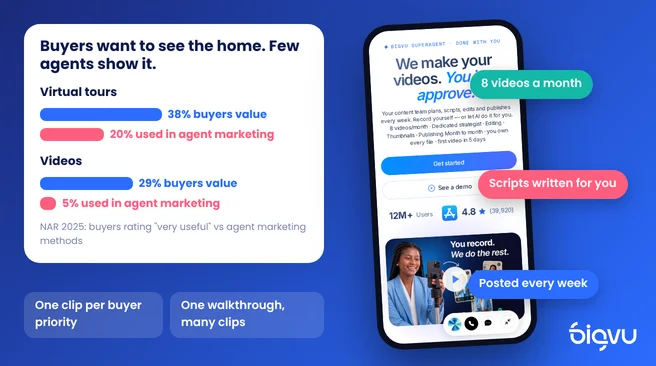
What buyers value once they are looking is worth noting too. In the same NAR report, 81 percent of buyers who searched online called photos very useful, 38 percent said the same about virtual tours, and 29 percent about videos. Keep those last two numbers in mind. We will come back to them.

The 2026 portal race: Zillow, Redfin, Realtor.com and Homes.com
Within about nine months, every major portal moved from filters to conversation. Here is the timeline, taken from each company's own announcements:
- October 6, 2025, Zillow in ChatGPT. Zillow launched an app inside ChatGPT where buyers type requests like "Show me homes with a big backyard." Tours, agent connections and financing still route back through Zillow.
- October 9, 2025, Realtor.com AI search. The new search reads listing photos to find single story homes and lets users filter across more than 300 terms and tags.
- November 13, 2025, Redfin conversational search. Redfin launched back and forth search on the web, then brought it to the iPhone app in January 2026. The feature is powered by Sierra.
- February 17, 2026, Homes AI. CoStar's Homes.com added two way search by voice or text, built on Microsoft Foundry, and promised that buyer inquiries "will always go directly to the listing agent."
- March 25, 2026, Zillow AI mode. A guided experience that lets people discover homes through conversation, then schedule tours or connect with a local agent. It is in beta with a limited group, with expansion planned through 2026.
- June 2, 2026, Realtor.com RealAssist AI. An AI first search built with Google Gemini, in beta for a select group of logged in users.
Note how many of these are still in beta. The point is not that every buyer uses AI search today. It is that the portals have decided this is where search is going, and each one has wired the conversation straight into a tour request or an agent introduction. You are not going to build a better search engine than Zillow. Your edge is what happens after the buyer raises a hand.

What a conversational search tells you about a buyer
A filter search tells you someone looked at a three bedroom house. A conversational search tells you why. Redfin reports that half of its conversational searches include something no filter can capture, and that people using the feature favorite, tour and share homes roughly 60 percent more often than people who do not. That is Redfin's own data about its own product, so treat it as a direction rather than a promise. Zillow makes a similar claim, saying people in AI mode are having "deeper, more substantive conversations" than they do in traditional search.
For an agent, the useful part is the language. A buyer who typed "home office with good light, near a park, quiet street" has handed you the script for your first reply. Compare two follow ups:
- Generic: "Thanks for your interest in 14 Oak Lane. Let me know if you would like to schedule a showing."
- Specific: "You mentioned a home office with good light. The back bedroom at 14 Oak Lane gets afternoon sun, and the park is a four minute walk. Here is a 45 second clip of both."
The second one proves you listened. It also gives the buyer something to forward to a partner, which is how a lot of tours actually get booked. Make a habit of writing down the exact words a lead used and building your first message, call opener and video around them.

The rules still apply: MLS data, filters and fair housing
Conversational search does not change the rulebook, and a few points matter before you add an AI tool to your own site or workflow.
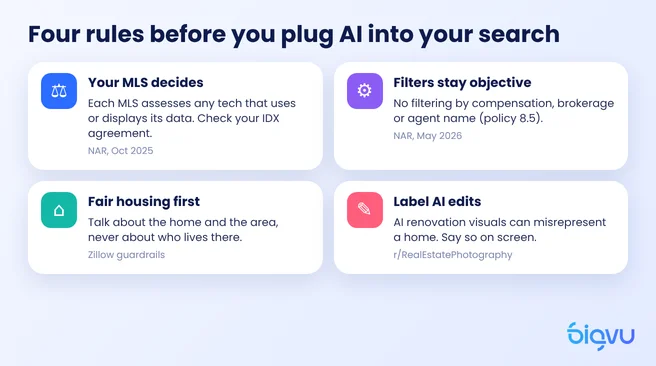
- Your MLS decides. When Zillow's ChatGPT app launched, NAR said that "each MLS is individually responsible for conducting its own assessment of technologies that use and display MLS data," including whether data reaches an unauthorized party and whether the broker keeps control of the display. Check your IDX agreement before plugging listings into any chatbot.
- Filters must stay objective. NAR's May 2026 guidance restates that MLS policy 8.5 bars filtering listings by cooperative compensation or by brokerage or agent name. Any criteria used to select listings for display should be measurable and applied equally to everyone's listings.
- Fair housing does not get a pass. Zillow says its ChatGPT app is built so that requests about neighborhoods "away from families" or "predominantly Hispanic areas" shouldn't be answered, and adds that "no system is perfect." Your follow ups should do the same: talk about the property, the commute, the park and the floor plan, never about who lives on the street.
- Label anything AI changed. AI renovation videos are spreading fast. One YouTube creator pitches agents transformation videos made from a single listing photo for $100 to $200 a property. Real estate photographers on Reddit warn that altered visuals can misrepresent a home and invite legal trouble. If you show a virtual makeover, say so on screen.
Turn search intent into real estate videos that convert
Go back to the NAR figures from the start: 38 percent of online buyers find virtual tours very useful and 29 percent say the same about videos. Yet in NAR's own breakdown of how agents marketed homes, virtual tours show up at 20 percent and video hosting sites at just 5 percent. Buyers want to see the place, and most agents are not showing it to them.
Closing that gap does not mean a film crew for every listing. A few habits cover most of it:
- Answer the search. When a lead names three priorities, record one short clip per priority. The kitchen, the yard, the walk to the coffee shop.
- Shoot once, cut many. Agents on r/RealEstateTechnology describe filming one real walkthrough and cutting it into feature clips for the kitchen, the view and the primary suite. It stays authentic and gives you a week of posts.
- Stay consistent. Brandon Upright of AI For Real Estate describes the usual pattern: agents post for a week, then go quiet for three. Buyers searching for ten weeks will notice the silence.
This is where AI video tools earn their keep for a small business. BIGVU SuperAgent is a done with you content team: a strategist plans and scripts your month, you record with the BIGVU teleprompter or skip the camera with a TalkingPhoto in your cloned voice, and the team edits with your brand kit, captions and thumbnails, then publishes a fresh drop every week. It delivers eight videos a month for $299 a month, or $239 a month billed yearly, with no long term lock in and your first video within five days. The portals will keep improving the search. Your job is to be the agent whose answer is already waiting when the buyer finds the right home.