Start with the message, not the software
Pardal's first point surprised the salespeople in the audience. "Marketing is not about tech. Marketing is sales," he said. A good cold caller making a hundred calls a day keeps adjusting the script based on what lands. Paid ads work the same way, just at a larger scale. The goal, in his words, is "a predictable system where you put $1 in, you're getting hopefully $5 back." That is a target to aim for, not a promise, and you only find out whether your offer can hit it by testing.
Let AI write the first drafts
Pardal says that as a media buyer he ran split tests after ChatGPT came out and saw that the AI written ads did better, were faster and cost nothing compared with paid copywriters. His process before opening any tool is simple enough to do on a blank page:
- Who is the one person you want to reach? He argues the more you niche down, the more each ad feels written for that person.
- What do they want? Write down the result they are hoping for in their own words.
- What is in the way? List the problems and doubts that stop them from buying.
Feed those answers to an ai script writer and ask for ad scripts, a 60 second video script and a short video sales letter that all point to the same call to action. BIGVU's AI Script Generator works as a video script generator for exactly this kind of draft, and the BIGVU teleprompter lets you read the result on camera without memorizing it.
The part AI does not do for you
Pardal is clear that the work never really ends. "The hardest part of marketing is getting the copywriting down," he said. Every week he split tests different hooks, different ways of describing the desire and different ways of describing the problem. The more specific the variations, the easier it is to read the data and keep improving without hiring an expert.

Capture leads with ad platforms and instant lead forms
The next stage turns views into clicks and clicks into contact details. Pardal's view is that this no longer needs a specialist. He says you can open an account at ads.tiktok.com in less than four minutes, and both Meta and TikTok now use machine learning to shift your budget toward the ads that perform and away from the ones that do not, as long as you set the budget at the campaign level and give the platform several ads to compare.
You may not need a website yet
"You need a way to capture a lead," he said, and lead forms solve that inside the ad platform. He describes them as "little mini websites" you can build in minutes, with ChatGPT or Claude writing the copy. When an audience member asked about video sales letters, his advice was to start with quick conversations through lead forms first, because they are easy to set up and get you conversations quickly.
What a small budget can look like
Pardal's own rule of thumb is that spending $20 to $50 a day gets you two to 10 leads on average. Treat that as one practitioner's estimate rather than a benchmark, since results swing widely by industry and offer. He was quick to add the more important point: "We don't just want leads, we want profitable leads." That is why he connects every form to a CRM such as GoHighLevel for small businesses, or HubSpot and Salesforce for larger teams, so each lead triggers an automated email and text and a link to book a call.
Tell the platform what a good lead looks like
The usual complaint about instant forms is junk leads. Meta changed two settings in August 2026 that address it, according to Justin Lalonde of goodadvertising.com. First, you can optimize for qualified leads instead of raw lead count, by sending Meta a sequence of events from your CRM, such as lead, then qualified lead, then purchase. He warns against telling Meta that only a purchase counts, because then "it stops caring about leads and our lead volume drops." Second, a new option lets you mark preferred answers on your form questions. You still receive everyone's details, but Meta looks for more people who answer the way your best customers do. He noted the toggle was still rolling out, so you may not see it yet, and that questions about income are not allowed for consumer leads.
Keep the content running
Ads work better when there is content behind them. In one client example, the owner posted 20 times in a month, and Pardal's team turned some of those posts into paid ads. If 60 posts a month sounds like too much, he suggests starting with one post every workday. This is where AI video tools earn their place in small business marketing: they make that volume realistic for a team of one.

Let video do the selling before the sales call
In the same client example, Pardal's team added a thank you video after the lead form that works like a video sales letter. Without it, he explained, prospects arrive on the call knowing only what they saw in your content, and you have to repeat everything. "The goal is to be able to get all their frequently asked questions answered before they even make it to the call." A short video watched right before or right after booking does that education for you.
He also noted that many people have the right scripts and never publish them because they are not comfortable on camera. BIGVU, which hosted the session, gives those people another route: record with a teleprompter, or create an AI avatar to present the script for you.
Video in follow up and outreach: what the numbers say
The same idea applies after the first contact. A few data points worth knowing, along with their limits:
- A controlled test. Prospectio ran an eleven week test in 2025 on 8,385 IT directors and CTOs at companies with 50 to 200 employees. Prospects whose first touch included a short video replied 40.4% of the time, against 28.8% for text only, and booked meetings at 6.4% against 4.1%, which is 57% more. The videos were about 30 seconds long and made one point and asked one question. The study did not capture what the videos cost to produce.
- A large forum report. A user on r/coldemail described adding personalized video to 35,000 cold emails. Replies went from 2% to 7.1% and meetings from 0.8% to 3.2%. Videos under 45 seconds worked best, and so did placing the video in the first email.
- A dissenting result. An SDR on r/salesdevelopment running Clay, Smartlead and Sendspark reported roughly three times more replies, but found video worked better in the second step than the first, and several commenters pushed back on the hype.
- The human argument. Sales trainer Morgan J Ingram, who says he has trained over 50,000 reps, shared that one rep sent 350 video DMs and scheduled 30 meetings, and another sent 10 to 20 messages a week with no automation and landed seven opportunities at billion dollar companies.
The pattern across all four is that short, specific, personal video tends to beat plain text, but where it sits in the sequence and how it is made both matter. With BIGVU Video Email Marketing you can record or generate a video message, and BIGVU builds a branded landing page with your logo, colors and a call to action button that opens when the prospect clicks the thumbnail in your email.
Personal at scale
If you send a lot of cold outreach, personalization tools can stretch one recording further. When our team tried Sendspark's trial on October 29, 2026, its guidelines told us to open the video with the phrase "Hey watermelon" so its AI could replace it with each prospect's name, updating the audio and the lips. Its share page greets each viewer by first name and holds CTA buttons and a calendar. Sendspark starts at $49 a month, or $468 a year. Whatever tool you use, the same rule applies: one short video, one point, one question.

Answer every lead in seconds with an AI receptionist
Everything above is wasted if nobody answers when the lead arrives. In a BIGVU session hosted by Bruno Lopes, marketer Jared, who runs digital marketing for a multifamily portfolio that he says now spans 19 properties in nine states and over 7,000 units, put it plainly: responding quickly "is the whole name of the game." Someone who finds a home on Zillow reaches out to an agent, and "if they don't hear back from that realtor very, very quickly, like let's say within seconds even, they're already moving on to the next listing." He saw it as a customer too. When he moved to California, he looked at 10 or 15 rentals with a different agent for each one, and only some of them followed up well.
What the research says about speed
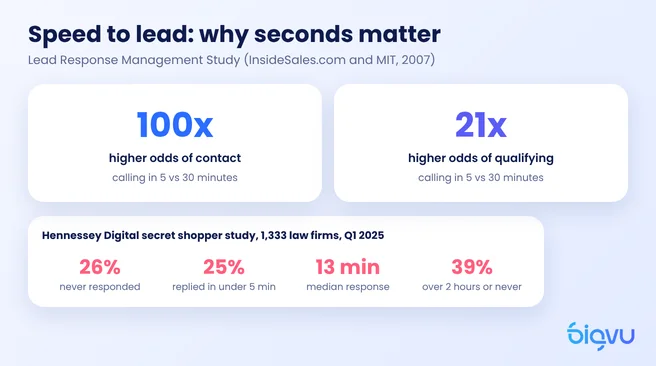
- The classic study. The InsideSales.com and MIT Lead Response Management Study, presented in 2007 by Dr. James Oldroyd, analyzed three years of data from six companies, more than 15,000 leads and over 100,000 call attempts. Calling within 5 minutes instead of 30 made the odds of contacting a lead 100 times higher and the odds of qualifying it 21 times higher.
- A recent secret shopper study. Hennessey Digital, a marketing agency for law firms, submitted contact forms to 1,333 firms in the first quarter of 2025. 26% never responded at all. 25% replied in under five minutes, up from 13% in 2021, and the median response time was 13 minutes. 39% took longer than two hours or never answered.
How an AI receptionist closes the gap
Jared built an AI receptionist called Jessica for AgencyFix. On the website she works as an assistant that can answer questions from a knowledge base of your listings and book appointments. On the phone, he can set her to pick up after a few rings during business hours and immediately after hours. For a client running Facebook lead ads, the AI texts each new lead right away, answers questions and books the appointment, and he says most people do not realize they are talking to AI. The AgencyFix AI receptionist page says Jessica answers in about seven seconds, around the clock, with free setup, texts back missed callers, books appointments and hands the conversation to a human when needed.
If you would rather run this inside your video stack, BIGVU VoiceMate is an AI voice concierge that answers by phone, WhatsApp and web chat from your own knowledge base, speaks in a cloned or library voice, books meetings through Google Calendar, Outlook or Cal.com and works in multiple languages. You can add it as a "Talk to our AI Agent" button on a BIGVU Page or embed it on your website with one snippet, with no developers needed.
Give them a reason to raise their hand
Jared's other tip is about the offer itself. Instead of a cold ad for a specific listing, he suggests lead magnets such as "What's my home worth?", instant valuation offers or "Get preapproved in five minutes", which he says convert dramatically better on Facebook. An AI assistant can deliver those answers on the spot and capture the email address while it does.
What AI receptionists cost and where they slip
Upfirst, which sells an AI receptionist, published a ranking of nine services after it says it signed up for and called more than 30 of them. It is open about being biased, since its own product is on the list. Even so, the video is useful because you hear real calls. Some are smooth, and the reviewer describes one demo as "a little awkward, but the integrations make it worth it." Upfirst's own pricing starts at $24.95 a month for 30 calls, with extra calls at $1.50 each on that plan, and it says plainly that it is not HIPAA compliant, so it is not a fit for healthcare practices. Before you choose, call the service yourself a few times, ask an awkward question, and check how it hands off to a human.
Know the rules and keep a human in the loop
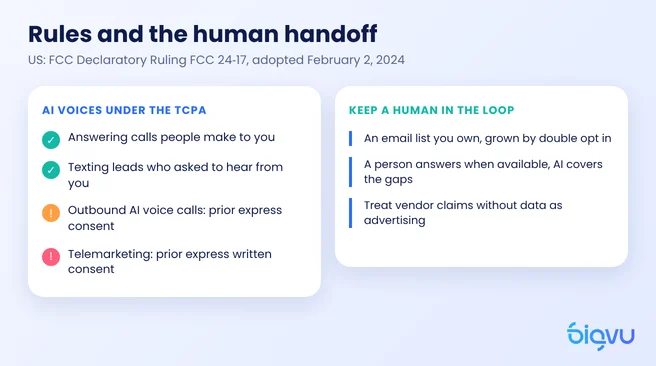
Speed is not a license to call anyone, any way you like. In the United States, the FCC confirmed in Declaratory Ruling FCC 24-17, adopted on February 2, 2024, that the TCPA's restrictions on "artificial or prerecorded voice" cover current AI technologies that generate human voices. Calls that use them require the prior express consent of the person called, and when the call includes telemarketing, prior express written consent. The ruling adds that the TCPA does not allow "any carve out of technologies that purport to provide the equivalent of a live agent." Answering a call someone made to you is a different situation from an AI calling your leads back, so check how your setup handles outbound calls before you switch it on. Text has its own consent rules too: the Hennessey study notes that registration and consent requirements for business texting have slowed how quickly law firms adopt it.
One rule you may have read about is not in force. In 2023 the FCC adopted a "one to one consent" rule for leads collected through comparison sites. On January 24, 2025, the Eleventh Circuit vacated that part of the order, holding that the law requires callers to get "prior express consent" and nothing extra, and the FCC postponed the rule the same day. The basic consent duty for AI voice calls still applies.
Read vendor claims with care
As an example of how AI callers are marketed, a short video from VelorinLabs, a company that builds AI voice agents, claims one of its agents "booked five appointments" in a single day and that another secured three listing appointments in its first week. No client, call volume or data is given, so treat claims like this as advertising, not evidence. The same video describes the agent making outbound calls, which is exactly the situation the FCC consent rule addresses.
Own the relationship
Two more points from Jared are worth keeping. First, build an email list you control, because "that email list that you have belongs to you" and no platform can change the rules on it. Grow it with permission through a double opt in rather than blasting old contacts. Second, AI is an assistant, not a closer. "AI is not a replacement for humans," he said. "People buy from people that they like." His suggestion is to have a person answer during the day when someone is available and let the AI cover the gaps.
Put together, the funnel looks like this: a clear message tested every week, ads that collect leads in a form, a short video that answers the usual questions, an instant reply from an AI receptionist, and a human who takes over once the lead is warm. That is AI for small business and video marketing working together, without handing the whole thing to an expensive agency.