
What Is an AI Voice Agent
An AI voice agent is software that answers your business phone like a real person would. It listens to what the caller says, figures out what they want, gives them an answer based on your actual business information, and can take action: book an appointment, write down their details, send them a text, or pass the call to you. The newest versions sound natural enough that most callers don't realize they're talking to software.
It's not the old-style phone menu
You know the kind: "Press 1 for sales, press 2 for support, press 3 for hours." Those menus route callers around badly and frustrate everyone. An ai phone assistant skips all of that. A caller can just say, "Do you do same-day plumbing repairs in zip 90210?", and the agent answers using your actual service area and availability. No buttons. No waiting through a list. Just a conversation.
The four things every good voice agent should do
There are dozens of these tools on the market, but for a small business, four things matter most:
- Answer every call within two rings — day or night, in a voice that doesn't sound like a robot.
- Answer using your actual business information including hours, services, prices, what areas you cover, what you don't do, instead of making things up.
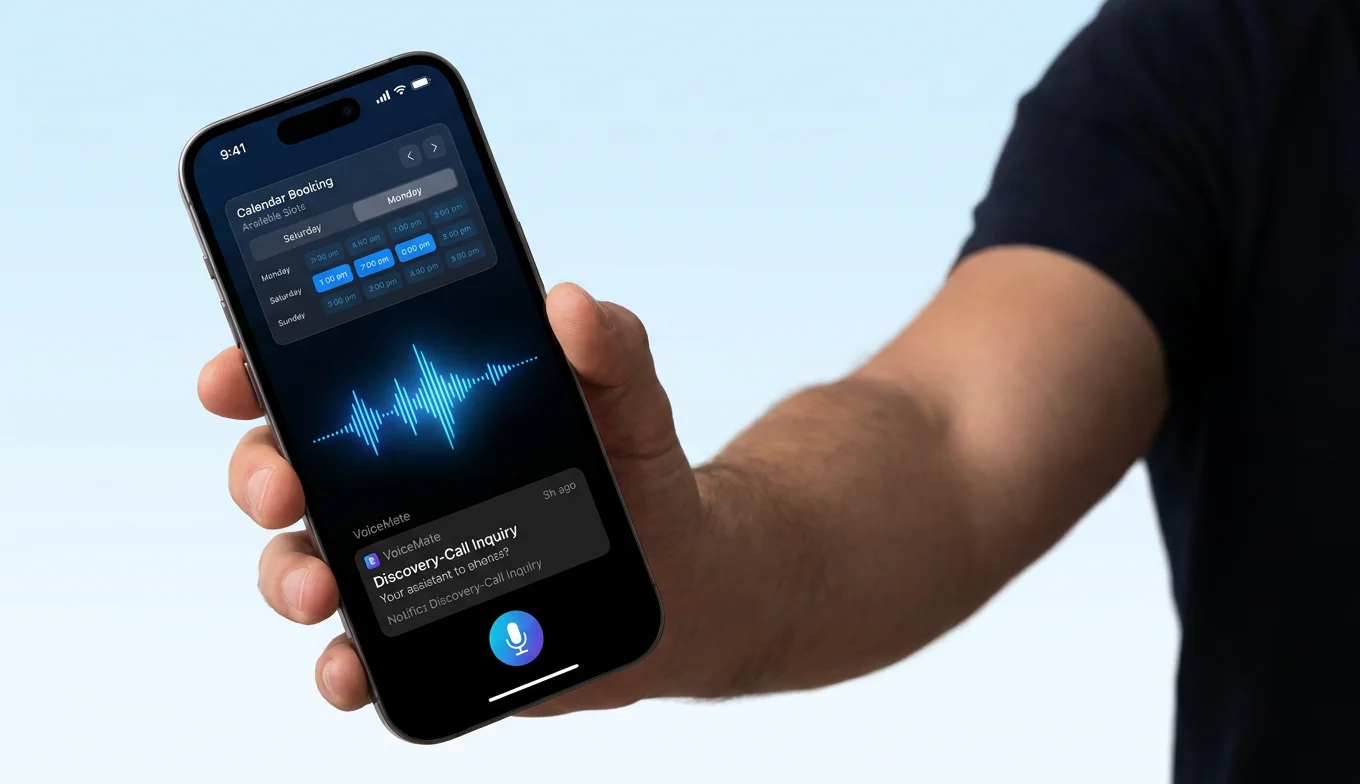
- Take action during the call — book the appointment into your calendar, write down the caller's contact info, send them a quote link by text, or transfer the call to you if it's urgent.
- Hand off cleanly with a summary of what the caller wanted and a transcript of what was said, so you can follow up without making the customer repeat themselves.
How it actually works (the simple version)
Think of an AI voice agent like a new employee on their first day. You hand them a folder with everything about your business — your services, prices, hours, common questions you get. They read it. Then they sit by the phone. When a call comes in, they answer, listen, find the answer in the folder, and respond. If something comes up they can't handle, they take a message and tell you about it.
The software version does the same thing, just faster and without breaks. You give it your business information (it can read your website, your social media posts, documents you upload). It uses that information to answer callers. Modern versions are good enough that the conversation feels normal — the agent listens while you talk, responds without long pauses, and handles interruptions without falling apart.
![[object Object]](/blog/images/airtable/section1-ai-voice-agent-small-business-guide-best-ai-voice-agents-202.webp)
Why Small Businesses Are Adopting AI Voice Agents Now
Three things changed in the last year or two that made AI voice agents go from "interesting demo" to "actually worth buying" for small businesses. The voices got good enough that most callers can't tell. The prices dropped to where catching one job pays for the tool for a year. And setting one up no longer requires a tech-savvy nephew.
The cost of missed calls is bigger than most owners realize
The 411 Locals study referenced in the intro is worth a closer look. It tracked 85 businesses across 58 industries over 30 days and found only 37.8% of calls were answered by a live person. Another 37.8% went to voicemail, and 24.3% got no response at all. And of the callers who do get sent to voicemail, 85% never call back. Run the numbers on your own business. If your average job is worth $275 and you close about 1 in 4 leads, missing five calls a week works out to roughly $71,500 a year in lost revenue. Even catching half of those missed calls with an ai answering service that costs $60 a month pays you back many times over.
The old options don't fit a small business anymore
A full-time receptionist costs $45,000 to $53,000 a year once you add benefits and taxes. They work 40 hours a week and go home at 5pm. Evening and weekend calls still go to voicemail. Human-staffed answering services like Ruby or AnswerConnect charge $500 to $800 a month for 100 calls, with extra fees that hit hardest during your busiest weeks. Both options also force the same scripted greeting onto every caller, no matter what they were calling about. AI voice agents fix both problems at once — lower price, and a real conversation instead of a script.
What's holding owners back is mostly trust
The technology works. What slows owners down is the fear of an awkward call: a stiff-sounding voice, the agent missing the point, a frustrated lead hanging up. That fear was reasonable a few years ago, and it's still reasonable for the cheapest tools. But the better ones have crossed the line where most callers can't tell they're talking to software. The honest answer is that quality still varies a lot between tools — which is exactly why the comparison in the next section matters.
![[object Object]](/blog/images/airtable/section2-ai-voice-agent-small-business-guide-best-ai-voice-agents-202.webp)
6 Best AI Voice Agents for Small Businesses Compared
These six tools were chosen for what a small business actually cares about: how natural the voice sounds, how easy the tool is to set up, what it costs at small-business call volumes, and what it can actually do beyond just picking up the phone.
BIGVU VoiceMate — Best for businesses that already post on social media
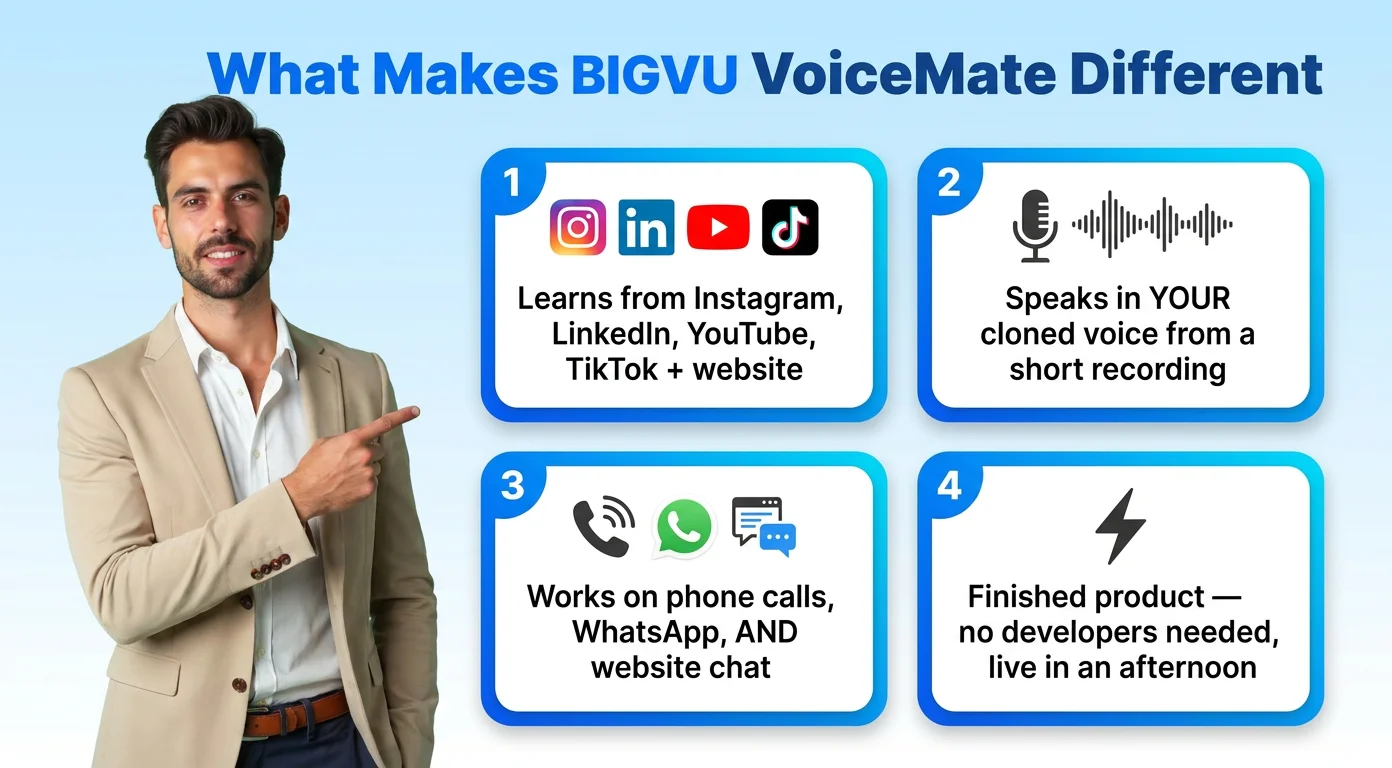
BIGVU's voice agent is the only tool on this list that learns about your business from your Instagram, LinkedIn, YouTube, and TikTok accounts — not just your website. Most other tools only read your website. That's a problem for most small businesses, because the real details about what you do, your prices, and your common questions usually live on social media, not on an "About" page.
VoiceMate also lets you copy your own voice. You record a short sample, and the agent then speaks in your voice on every call. Callers hear you, not the same generic woman-with-a-business-tone voice that 50 other companies in your area are also using.
It handles calls, WhatsApp messages, and chats on your website — most other tools only handle phone calls. Setting it up takes no technical skills: paste in your social media links, pick a voice, connect your calendar, done. You can be live in an afternoon.
Best for: coaches, consultants, agencies, clinics, and service businesses where your personal brand and voice are part of what you sell.
Lindy — Best if you want to connect calls to your other business tools
Lindy is one of the most flexible tools on the market. It connects to thousands of other apps, so the agent can do things like: answer a call, book the appointment, add the customer to your contact list, and email you a summary — all in one go. It starts at about $50 a month and covers a moderate volume of calls.
The trade-off is that Lindy is more of a general-purpose AI tool than a phone-specific one. You'll spend more time getting it to answer calls exactly the way you want, especially when it comes to teaching it about your specific business.
Best for: small businesses that already use a lot of software tools and want one platform that ties calls together with their other work.
Synthflow — Best if you want one all-in-one bill
Synthflow bundles everything you need — the voice, the speech recognition, the phone line — into one monthly subscription. You don't have to sign up for five separate services to make it work. The setup is visual: you drag and drop boxes to show how the agent should handle different kinds of calls. It also supports multiple languages out of the box.
The catch is price. The starter Pro plan is about $375 a month for 2,000 minutes of calls, and the next tier up is around $750 a month. There's no real "small starter" plan, which leaves growing businesses in an awkward middle.
Best for: businesses with steady, moderate call volume that want one bill and a setup they can edit themselves without writing code.
Retell AI — Best if you only want to pay for what you use
Retell AI charges by the minute — about 7 cents per minute of calls, with no monthly fee. New accounts get $10 of free credits to try it. The voice quality is genuinely good (the agent responds in about two-thirds of a second), and the setup uses drag-and-drop tools that are nicer to work with than most.
The catch is that Retell gives you the platform but expects you to connect a few extra services yourself to make it fully work — things like the phone number provider and the AI brain that powers the conversation. It's not hard for someone comfortable with tech, but it's not a one-click product either.
Best for: owners who are comfortable with software, agencies running calls for several clients, or businesses where call volume jumps up and down.
Rosie — Best for one-person businesses and home services
Rosie is the most small-business-friendly tool on this list. It reads your website and your Google Business listing, learns your business in a few minutes, and is built specifically for people who can't answer the phone while they're working a job. Plans start at $49 a month, with a 7-day free trial.
The voice is warm and natural — a real strength. The limitation is depth: Rosie is essentially a smart message-taker that answers common questions and books appointments. It doesn't handle complex situations or branch into many different conversation paths the way BIGVU or Lindy can.
Best for: plumbers, electricians, HVAC technicians, landscapers, and other solo professionals who need calls answered well, not orchestrated into a complex workflow.
Goodcall — Best for businesses that get the same questions all day
Goodcall lets you map out exactly how different kinds of calls should be handled — different times of day, different reasons for calling, different next steps. The starter plan is $59 a month for up to 100 different callers.
It's a strong fit for restaurants, retail shops, and businesses that get asked the same handful of questions over and over ("Are you open?" "Do you take walk-ins?" "Can I book for Saturday?"). The downsides: pricing gets expensive if you cross 100 unique callers in a month, and the voice sounds noticeably less natural than the newer tools on this list.
Best for: restaurants, retail, and businesses where the same questions repeat constantly and you want consistent answers every time.
Quick comparison
BIGVU VoiceMate — Low price — Calls + WhatsApp + website chat — Learns from social media, copies your voice — Coaches, agencies, service businesses with an online presence
Lindy — Around $50/month — Calls + chat — Connects to thousands of other apps — Businesses that use a lot of software tools
Synthflow — Around $375/month and up — Calls only — One bill for everything, visual builder — Steady moderate-volume businesses
Retell AI — 7 cents per minute, no subscription — Calls only — Pay only for what you use — Tech-comfortable owners, agencies
Rosie — $49/month and up — Calls only — Learns from your website automatically — Solo operators, home services
Goodcall — $59/month and up — Calls only — Map out exactly how different calls should be handled — Restaurants, retail, repetitive questions
![[object Object]](/blog/images/airtable/section3-ai-voice-agent-small-business-guide-best-ai-voice-agents-202.webp)
What Makes BIGVU VoiceMate Different for Small Businesses
Most voice agent tools solve one piece of the problem: they answer the phone. BIGVU VoiceMate solves a bigger one: how does a small business that already lives on Instagram, LinkedIn, YouTube, or TikTok turn all that existing content into a 24/7 phone helper — without rebuilding everything for a separate tool?
It learns from where your business actually lives
Other tools read your website. That's fine if your website is rich and up to date. For most small businesses, it isn't. The real pricing conversations happen in Instagram comments. The most common questions get answered in YouTube videos. The customer stories live on LinkedIn. BIGVU pulls from all of those places — plus your website and any documents you upload — and uses them to answer calls. When someone asks about your prices, the agent gives the same answer your audience is already seeing on your social channels. It doesn't have to guess.
It can speak in your actual voice
Most AI voice agents use one of a handful of stock voices. After a while, callers start recognizing them — the same "professional woman" voice across every business they call. BIGVU lets you copy your own voice from a short recording. When someone calls your business, they hear you. Same tone. Same accent. Same energy as the videos and reels they may have already watched. For coaches, consultants, and any business where the owner is the brand, that's a completely different level of trust.
It works on calls, WhatsApp, and your website — all at once
Most voice agents handle phone calls and stop there. BIGVU VoiceMate handles phone calls, WhatsApp messages, and chats on your website — the same agent, the same business knowledge, the same voice across all three. A prospect who found you on Instagram can message your business and get an answer right away. A visitor on your website can click "Talk to our AI Agent" and start a conversation. Both go into the same calendar and the same lead list. For a small team, this matters a lot. Running three separate tools to cover three channels is a tax most small businesses can't afford in time or money.
It's a finished product, not a kit
Some of the bigger names in this space (Vapi, Retell AI, and a few others) sell the parts — the voice, the AI brain, the phone connection, the call logic — and expect you to wire them together yourself. That works for engineering teams. For a busy small business owner, BIGVU is the assembled product: paste in your sources, pick a voice, connect your calendar, embed on your site. No developers. No technical setup. No engineering hours billed by your nephew. You can set up an ai virtual receptionist and start taking real calls in the same afternoon you decided to try it.
How to Choose the Right AI Voice Agent for Your Business
There's no single "best" AI voice agent for every small business. The right tool depends on what you sell, how customers find you, and how much you want to manage. Here's a way to narrow it down in five minutes.
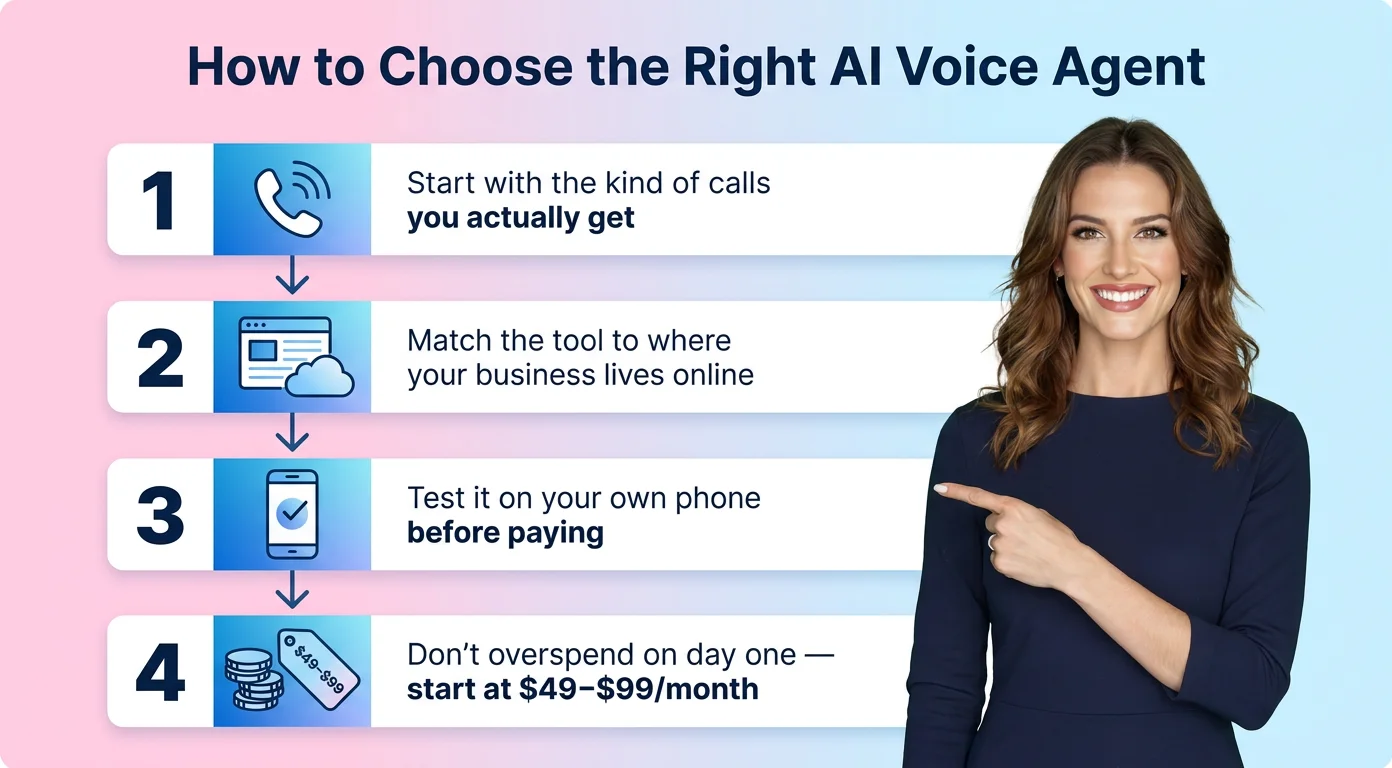
Start with the kind of calls you actually get
If your callers ask the same handful of questions every day (restaurant hours, basic service info, simple bookings), a simple tool like Rosie or Goodcall is enough. If callers ask varied, detailed questions about specific services or prices, you need a tool that knows more about your business — BIGVU VoiceMate, Lindy, or Synthflow. If your business is mostly about making calls out (following up with leads, sending appointment reminders, collecting payments), look at Retell AI for its pay-per-minute pricing.
Match the tool to where your business already lives online
If most of your business information is on your website and Google Business listing, Rosie or Goodcall will pick up what they need quickly. If the real details about your business — your services, prices, common questions, customer stories — live across Instagram, LinkedIn, YouTube, and TikTok, an ai phone receptionist like BIGVU that pulls from all those places will sound a lot more like your actual business than a tool that only reads one website.
Test it on your own phone before paying
Every tool on this list offers a free trial or free credits. Pick one. Spend an hour setting it up with your real business information. Then call your own number from your cell phone. Ask the hardest question a customer ever asks you. Then ask the follow-up. If the agent falls apart, it'll fall apart with real customers too. If it sounds like your business and gives the right answer, you have a winner.
Don't overspend on day one
The biggest mistake small businesses make with voice agents is buying the expensive plan for a problem that the cheap plan can solve. Most small businesses can prove the tool is worth it on a $49 to $99 a month plan within the first month. Catch one or two missed jobs, and you've paid for a year. Start with the simplest plan that covers your call volume. Move up only when you can see why you need to. The math works because one captured job is almost always worth more than a year of the tool.