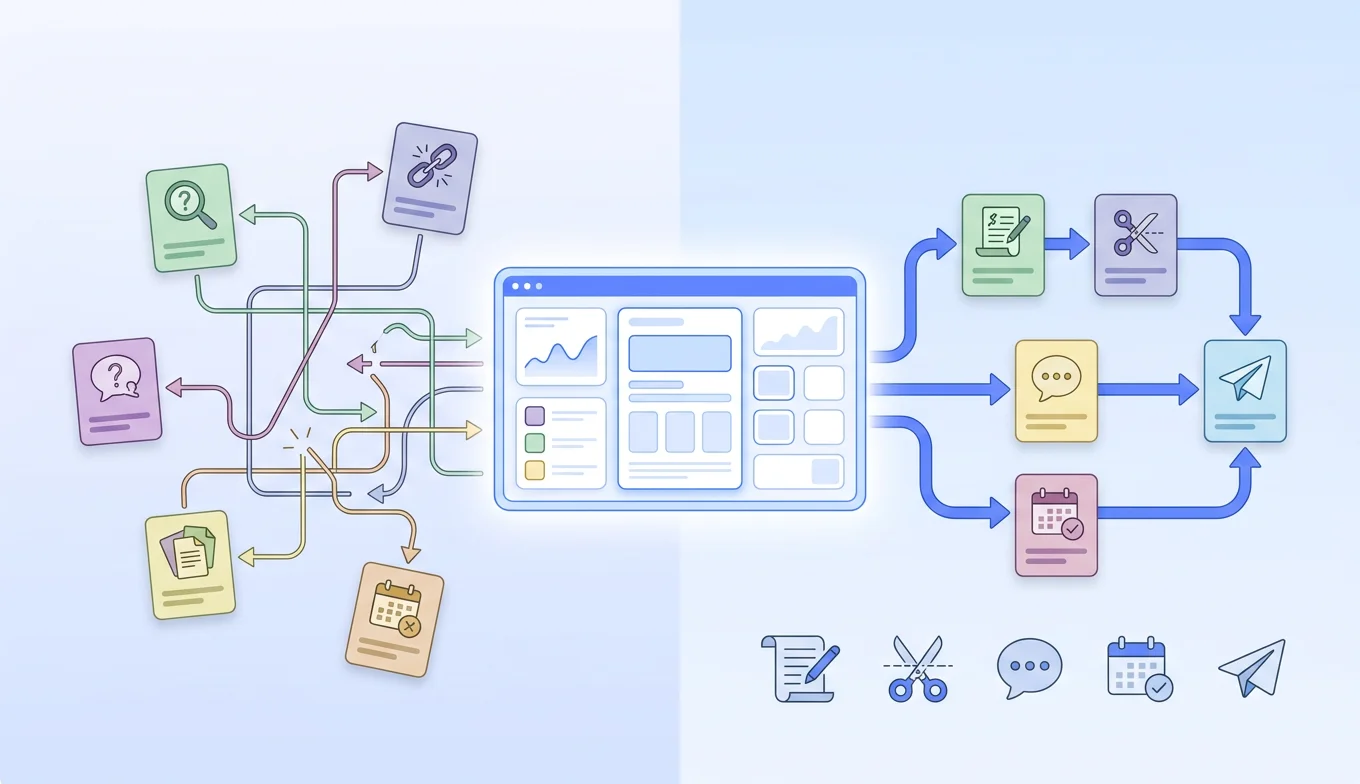
Why agents start strong and then go quiet
A single video is not one task. It is a topic, a script, filming, editing, captions, branding, a thumbnail, a version for each platform, the post itself, and a look at what worked afterwards. Each step is small. Together they take real time, every week, forever.
One agent on r/realtors described a lean version of this: he showcases a property or two each week, which "takes 30 to 45 minutes for footage, about an hour of edits" and gives him content for a week or two. That is a good system for one person, and it still depends entirely on him having those hours free.
Real estate is a job where the busy weeks are not optional. Showings, inspections, and closings have deadlines and people waiting on them. Content has neither, so it is the first thing that slips. The cost shows up later. In the same Adobe Express survey, 63 percent of owners said they saw a drop in followers or engagement when they posted less.

It is not a willpower problem
The usual advice is to try harder: block the time, batch the content, stay disciplined. That advice assumes the missing ingredient is motivation. The research on habits suggests something else.
In a well known 2010 study of 96 volunteers, Lally and colleagues found that a new daily behavior took a median of 66 days to become automatic, with individual results ranging from 18 to 254 days. About half of the participants never did the behavior consistently enough to reach habit status at all. A 2024 systematic review in Healthcare concluded that people "should anticipate a timeframe of at least two to five months". Both looked at simple health habits like eating fruit at lunch or drinking water, not a ten step production workflow, which only makes video harder.
Then there is the camera itself. In Chapman University's 2024 Survey of American Fears, 29.0 percent of Americans said they were afraid or very afraid of public speaking. That is not the same as camera fear, but anyone who has hit record knows the overlap. One agent put it plainly on r/realtors: "I hate being on camera. When I start making actual money in this job, I'll be hiring a content creation assistant before a TC because I hate it so much."
A habit that takes months to form, built on a task many people dislike, competing with work that has real deadlines, will break. That says more about the setup than about you.

What staying consistent actually requires
Some agents do keep going on their own, and it is worth looking at how. Christian Walsh, a realtor interviewed on The Katie Lance Podcast in April 2025, started with two YouTube videos a week and edited them himself. His rule was fixed: if videos go out Wednesday and Friday at noon, he shoots and edits Tuesday and Thursday night. He says more than half of his listing leads now come from YouTube, which is his own figure. He also has an operations director who reposts his videos to other platforms, and he admits he has since "backed off a bit" from two a week.
Broker Josh Ries wrote in Inman about posting 30 times a day for 30 days with AI assisted batching, in "no more than one to two hours a day", and reported about 110,000 views. He fell short of his target after getting sick, and his takeaway was that "a strong content system... protects your momentum when you're not." Most agents do not need 30 posts a day. Broker Kendall Bonner suggests posting weekly to get started.
Put those together and the requirements are clear:
- A fixed slot on the calendar that does not move when the week gets busy.
- A backlog of scripts and finished videos, so one bad week does not mean an empty feed.
- Someone else on the downstream steps. Even Walsh, who edits his own videos, hands off distribution.
If you can protect two evenings a week, the do it yourself route can work. If you cannot, the answer is to take yourself out of every step that does not need your face or your judgment.

How done-for-you keeps you visible every month
This is the part BIGVU SuperAgent takes off your plate. The process is short:
- A 30-minute kickoff call to map your channels, your audience, and the video styles that fit your market.
- Scripts written for you in your brand tone, around the questions your clients actually ask. You can also send your own or mix the two.
- You choose how each video gets made. Record it with the BIGVU teleprompter, or skip the camera with a TalkingPhoto in your cloned voice.
- Editing in your style with your brand kit, captions, and thumbnails, plus one round of notes.
- Publishing every week to the channels you use, with a monthly report on what worked.
That is eight videos a month, a dedicated strategist, and a named producer on Slack or email. It is month to month, you own every file and the raw footage, and the first video goes live within five days of your footage.
A steady monthly output matters most in the months agents tend to disappear. NAR data shows 240,000 existing homes sold in January 2025 against 391,000 in June, before seasonal adjustment. Sales are counted at closing, so the searching and agent interviews behind the summer peak happen earlier in the year. A quiet month for listings can still be a full month of market updates, seller questions, and neighborhood videos, because the eight slots do not depend on having a new listing.
One St. Louis agent who had been posting neighborhood videos since 2022 wrote that views finally picked up once he focused on being in front of the camera and handed the editing and technical side to an agency. "The relocation buyers who find me through YouTube are a different kind of lead," he wrote. "They already know my face." It is a single forum post with no hard numbers, but it shows the split that works: you talk, someone else produces.
On cost, SuperAgent is $299 a month billed monthly, or $239 a month on the yearly plan. The alternatives add up quickly. A social media manager has a median salary of $85,000, film and video editors earn a median of $75,420, and Upwork, a freelance marketplace, lists a median of $10 an hour for entry level editors and $100 an hour for senior ones, before you count the hours spent briefing them.

Staying you while staying consistent
Handing off production only works if the videos still sound like you. That is the worry agents raise most, and it has a practical answer.
Scripts help more than people expect. Agent John Alesi wrote on ActiveRain that his delivery is smoother with a complete script, and that he reads it aloud 5 to 10 times on a teleprompter app so he sounds "like I'm talking and not reading." Kendall Bonner recommends a teleprompter, "such as BigVu or Teleprompter", and suggests limiting yourself to three takes: "Your imperfections are your connection!" Walsh made the same point in his own way: "People are self conscious on video, but that's what you look and sound like to all of us."
Your audience can also tell when the person disappears. Pew Research found that 76 percent of Americans say it is extremely or very important to know whether content was made by AI or by people. In a 2026 peer reviewed field test of 384 Facebook ads, an AI avatar got 25 percent more video plays but 38 percent fewer clicks than a human spokesperson. If you use a TalkingPhoto or any realistic synthetic video, YouTube asks creators to disclose it, so label it.
So keep the parts that make you, you: your opinions on the market, your client stories, your face on camera. Approve every script before it is produced. Let the team handle the drafting, editing, captions, and posting. If you have quit video before, another burst of motivation will not fix it. A setup that keeps running when you get busy will. To see what that would look like for your market, book a free 20-minute strategy call with SuperAgent and get a recommendation for your first eight videos.