
PlayPlay Review: The On-Brand Video Maker Built for Enterprise Teams
PlayPlay sells itself as visual creation your whole team will enjoy. This is a video tool for marketing, communications, HR, and internal comms teams inside mid-size and large companies. It leans hard into brand consistency, collaboration, and speed, and it has the logos to back the pitch, with more than 3,000 companies including L'Oreal, Booking.com, Heineken, IBM, and NHS Scotland listed as customers. On G2 it holds a strong 4.7 out of 5 rating across more than 300 reviews.
How PlayPlay Actually Works
PlayPlay is browser-based, so there is nothing to install. You start a video from a template, from scratch, or with the AI Video Assistant, then build it screen by screen. Each screen is a building block with its own media, text, icons, and layout, and you stack them into a sequence rather than editing on a traditional layered timeline. A large template library, a stock library of images and video, and an audio bank give you the raw material, and a Brand Kit pushes your logos, colors, and fonts across everything the team makes. The AI features are the current headline. There is an AI Video Assistant that drafts a video from a prompt, AI voice generation and voiceover, auto subtitles, and a newer add-on called PlayPlay Design that turns text prompts into on-brand images and animations at no extra cost. A Tools menu adds AI Clipping to cut long videos into short social clips, an AI Translator to localize videos, plus screen and camera recording, GIF export, and branded landing pages. There is even a live AI tips panel that reviews your video and flags issues like low music volume or weak contrast.What Users Like About PlayPlay
The praise is very consistent across reviews:- It is genuinely easy to start. Reviewers repeatedly describe the setup as intuitive and say people at any skill level can produce a professional-looking video quickly.
- The results look polished. Users making everything from product videos to interviews report being happy with the output, and several mention the AI voiceover sounds natural.
- The libraries save time. The template, image, and video libraries, plus easy import of outside material, get called out as a real speed advantage.
- Support and account management stand out. Reviewers mention dedicated account managers, responsive chat, and the reassurance of talking to a real person.
- It keeps evolving. Frequent new features and visible responsiveness to feedback come up again and again.
What Users Dislike About PlayPlay
The complaints are just as consistent, and they cluster around flexibility and polish:- Limited creative freedom. Experienced video makers say the screen-based approach lacks the control they get in a tool like Adobe Premiere, and that customization and text handling feel restricted.
- Editing quirks and bugs. Several reviewers hit issues when trimming on the timeline bar or replaying during editing, and some have to refresh the page for changes to appear.
- Language limits on AI generation. The AI video generator has been reported to support only English, German, and French, which is a real gap for global teams.
- No subtitle file export. Users have asked for SRT export so they can reuse captions elsewhere.
- The audio library feels same-y. The music in the audio bank is described as repetitive, with a shortage of sound effects.
PlayPlay Pricing
PlayPlay runs on a sales-led model. You can start a 7-day free trial with no credit card, but the trial keeps PlayPlay branding on your videos and locks features like single sign-on. To actually subscribe, you click Talk to an expert and request a custom quote. There is no public price and no self-serve monthly plan, which suits its enterprise buyer but makes it hard for a small team to know the cost before a sales call. Plans are typically annual.PlayPlay: Best For
- Brand, marketing, and internal comms teams at mid-size and large companies that need strict brand consistency across many creators
- Teams that want templated, on-brand motion graphics and text-driven videos without anyone appearing on camera
- Organizations that value a dedicated account manager and a guided rollout over self-serve speed
- Companies with the budget for an annual enterprise contract
PlayPlay: Not Ideal For
- Solo creators, founders, and small businesses who want to try before a sales call and see a price up front
- Anyone whose core need is talking-head video, where a teleprompter and confident on-camera delivery matter most
- Global teams that need AI video generation in more than a handful of languages
- Editors who want deep, layer-level creative control
![[object Object]](/blog/images/airtable/section1-playplay-bigvu-ai-video-platform-wins-2026-features-pricing-.webp)
BIGVU Review: The Web-and-Mobile Video Studio for People Who Show Up on Camera
Where PlayPlay is built around assembling branded screens, BIGVU is built around getting you into video, on camera or not. It runs on both web and mobile, with your scripts and videos syncing across devices, so a business owner, marketer, real estate agent, or creator can script, record, caption, brand, and publish from a desk or a phone. On review sites it is used most by small businesses and marketing teams, and the teleprompter is the feature people fall in love with first.
When You Want to Be on Camera: Script and Teleprompter
The on-camera workflow starts before you hit record. You use the AI Script Generator to turn a topic into a tight, video-ready script, then load it straight into the live scrolling teleprompter. You read while the camera captures your face, so you keep eye contact and sound prepared instead of stumbling or glancing off to the side. There is even AI eye-contact correction and beauty filters to help you look your best. Then you apply your Brand Kit in a tap, burn captions directly into the video so it works with the sound off, and publish. The whole loop can happen on your phone or in your browser, and you can start on one device and finish on the other.When You Do Not Want to Be on Camera: AI Avatars and Portrait to Video
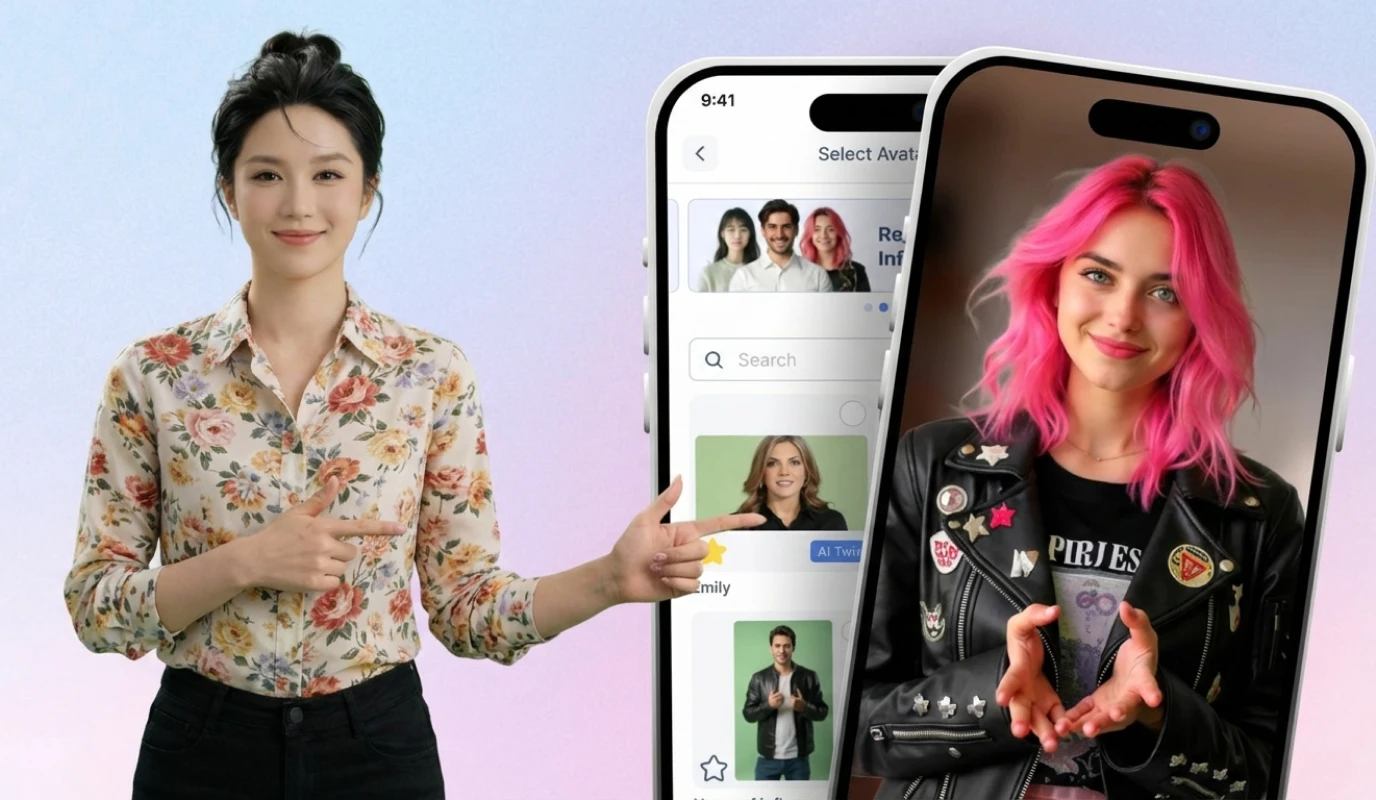
Not everyone wants to film themselves, and BIGVU gets that. The AI Avatar Video Generator turns a script into a fully presented video without a single recording session. Portrait to Video, also called AI Talking Photo, animates a single headshot so a still photo delivers your script with synced lips and expression. And with AI voiceover and voice cloning, you can narrate in your own voice, or a natural-sounding AI voice, across 20+ languages, without ever picking up a mic. It is the same finished, on-brand video, just without the camera.Turn Video Into a Lead Machine: Pages, Email, VoiceMate, and Connectors
This is where BIGVU stretches past pure video creation into video marketing. Any video can become a branded video landing page with your headshot, a headline, and a call-to-action button, or go out as a video email that arrives with an animated preview and tracks who watched. VoiceMate, BIGVU's AI voice agent, then answers the leads those videos bring in, across calls, WhatsApp, DMs, and website chat, learning from your own content and even speaking in your cloned voice so it sounds like you. A set of connectors ties it all together, publishing to 20+ social accounts, sending from Gmail or Outlook, and plugging into tools like Zoom, so the video you just made goes everywhere without exporting and re-uploading.The Features That Set BIGVU Apart
- Live scrolling teleprompter. The signature tool. It moves at your pace so on-camera delivery looks natural and confident.
- AI Script Generator. Removes the blank page. Give it a topic and get a script written for spoken delivery with a clear hook.
- AI Avatars and Portrait to Video. Create a scripted video without filming, or animate a single headshot to deliver your message when you would rather not be on camera.
- Burned-in captions. Captions are baked into the video, not a toggle, so they show up everywhere social video is watched on mute.
- AI voiceover and voice cloning in 20+ languages. Add narration, or your own cloned voice, without recording.
- Fototale. Turn photos or a listing link into a narrated, branded video, a favorite among real estate agents.
- Brand Kit and overlays. Logo, colors, and fonts applied inside the video, so it stays yours even when shared.
- Video pages and video email. Turn any video into a branded landing page or a trackable video email that captures leads.
- VoiceMate AI voice agent. Answers inbound leads across calls, WhatsApp, DMs, and website chat, in your cloned voice.
- Connectors and social publishing. Publish to 20+ social accounts and send from Gmail or Outlook, all from one workflow.
What Users Like About BIGVU
Reviewers keep circling back to the same points: it makes recording feel easy, the teleprompter lets people read a script without looking like they are reading, scripts and edits move smoothly between phone and desktop, and it is built with social formats in mind, so videos come out in the right aspect ratio for each platform. The speed of going from idea to posted video is the recurring theme.BIGVU Pricing
BIGVU is refreshingly transparent, and the opposite of a sales call. It is free to start with a free plan on web or mobile, so you can test the workflow before paying, and paid plans remove the watermark and unlock the full toolkit. Paid plans start low, in the single digits per month on annual billing, with higher AI tiers for creators who want more credits. Save big with Yearly billing. You see the price, pick a plan, and start, no quote required.BIGVU: Best For
- Founders, small businesses, marketers, coaches, and real estate agents who want a consistent video habit, on camera or not
- Creators who want to script, record, caption, and publish social video from web or mobile
- Anyone who is camera-shy or does not want to film at all, since the AI script and teleprompter, or AI avatars and portrait to video, cover both
- Teams that want video to actually generate leads, through branded video pages, video email, and the VoiceMate voice agent
- People who want a free plan and transparent pricing before committing
BIGVU: Not Ideal For
- Large enterprise teams that need heavy brand governance and admin controls across dozens of non-camera creators, which is where PlayPlay leans in
- Teams whose videos are purely templated motion graphics with no one on camera and no AI presenter
![[object Object]](/blog/images/airtable/section2-playplay-bigvu-ai-video-platform-wins-2026-features-pricing-.webp)
PlayPlay vs BIGVU: Ease of Use and the Real Learning Curve
Both tools are marketed as easy, and both are, but they are easy at different things, because their core metaphors are different.
PlayPlay is easy when your video is an assembly job. You pick a template, drop your text and media into screens, apply the brand kit, and export. For a comms manager who needs a clean, on-brand announcement or a product explainer built from stock footage and motion graphics, it is fast and forgiving. The learning curve shows up when you want to break the template. Reviewers who came from real editing software describe the screen-based system as restrictive and note that fine control over text and layout is limited. In short, it is easy to start and harder to bend to your will.
BIGVU is easy when your video is you. The friction it removes is not layout, it is the two things that actually stop most people from making video: not knowing what to say, and freezing on camera. The AI Script Generator handles the first, the teleprompter handles the second, and captions and branding are one tap each. The learning curve here is mostly getting comfortable reading from a teleprompter, which takes a session or two, after which batch recording ten videos in one sitting becomes realistic.
The honest summary: if no one wants to be on camera and the goal is polished branded graphics, PlayPlay feels easier. If the goal is a real person talking to an audience, BIGVU removes the friction that PlayPlay does not even try to address.
![[object Object]](/blog/images/airtable/section3-playplay-bigvu-ai-video-platform-wins-2026-features-pricing-.webp)
PlayPlay vs BIGVU: Features and Pricing Compared
Here is where the two platforms line up, and where they clearly split.
Feature Comparison
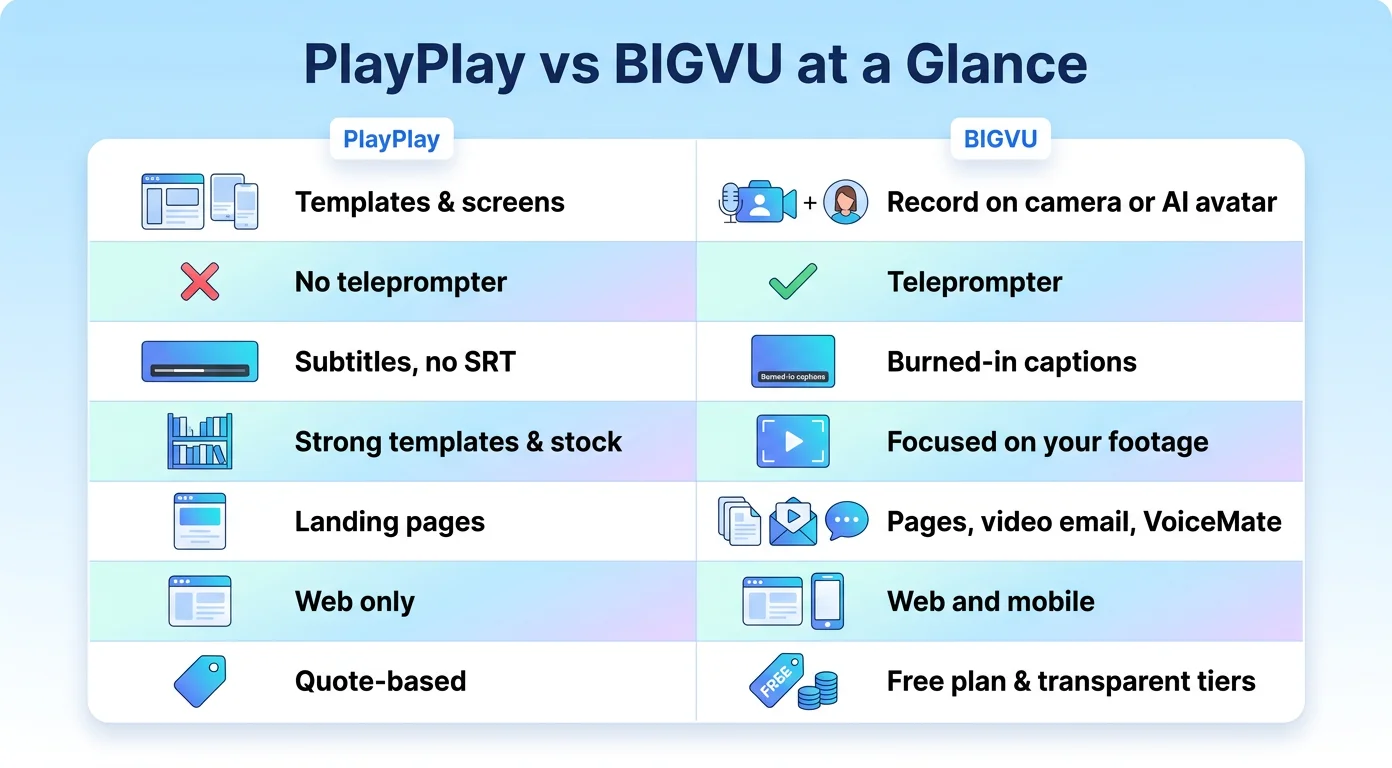
- Core approach: PlayPlay builds videos from templates and screens in the browser. BIGVU records you on camera on web or mobile, or creates the video with AI avatars and portrait to video when you would rather not film.
- Teleprompter: BIGVU has a live scrolling teleprompter as its flagship feature. PlayPlay does not center on-camera recording this way.
- AI scripting: BIGVU generates spoken-word scripts built for delivery. PlayPlay's AI drafts full templated videos from a prompt.
- Captions: BIGVU burns captions into the video. PlayPlay adds subtitles, but reviewers note there is no SRT export.
- Templates and stock: PlayPlay is stronger here, with a large template library, stock media, and an audio bank. BIGVU focuses on your own footage plus branding.
- AI voice and avatars: Both offer AI voice. BIGVU adds AI Avatars, Portrait to Video, and voice cloning for no-film videos. PlayPlay adds PlayPlay Design for on-brand AI images.
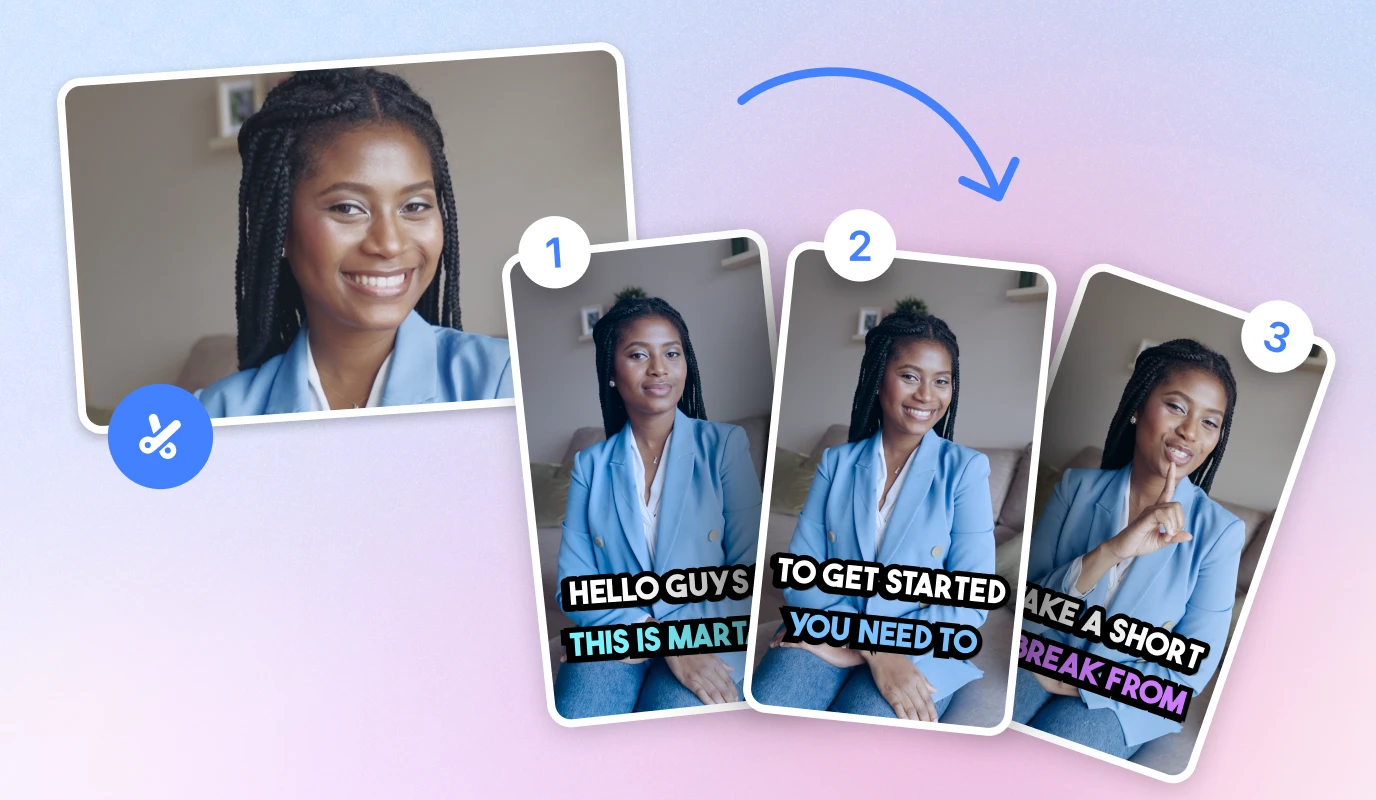
- Repurposing: Both cut long videos into short clips. PlayPlay has AI Clipping, BIGVU has Auto-Shorts, and BIGVU adds direct social publishing.
- Marketing and lead gen: BIGVU turns videos into branded landing pages and trackable video emails, adds the VoiceMate AI voice agent to answer inbound leads, and connects to 20+ social accounts plus Gmail and Outlook. PlayPlay offers branded landing pages but stays focused on creation rather than email or lead capture.
- Localization: PlayPlay has an AI Translator, though its AI video generation has been reported to support only English, German, and French. BIGVU's AI voiceover spans 20+ languages.
- Platform: PlayPlay is browser-based. BIGVU works on both web and mobile, with iPhone and Android apps plus a web app that sync, so you can make a full video at your desk or on your phone.
- Built for: PlayPlay for enterprise brand and comms teams. BIGVU for creators, founders, and small businesses.
Pricing Comparison
This is the sharpest contrast. PlayPlay uses a sales-led, quote-based model. You get a 7-day free trial with branding on your videos, and to subscribe you talk to an expert for a custom, typically annual, enterprise price. You will not find a number on the pricing page. BIGVU does the opposite. There is a free plan you can use today on web or mobile, transparent paid tiers that start in the single digits per month on annual billing, and higher AI tiers for creators. Yearly billing saves big, and there is no sales call between you and getting started. For a large organization with procurement and a brand-governance mandate, PlayPlay's model is normal and the account management is a feature. For a solo creator, founder, or small team that wants to see a price and start today, BIGVU's transparency wins on its own.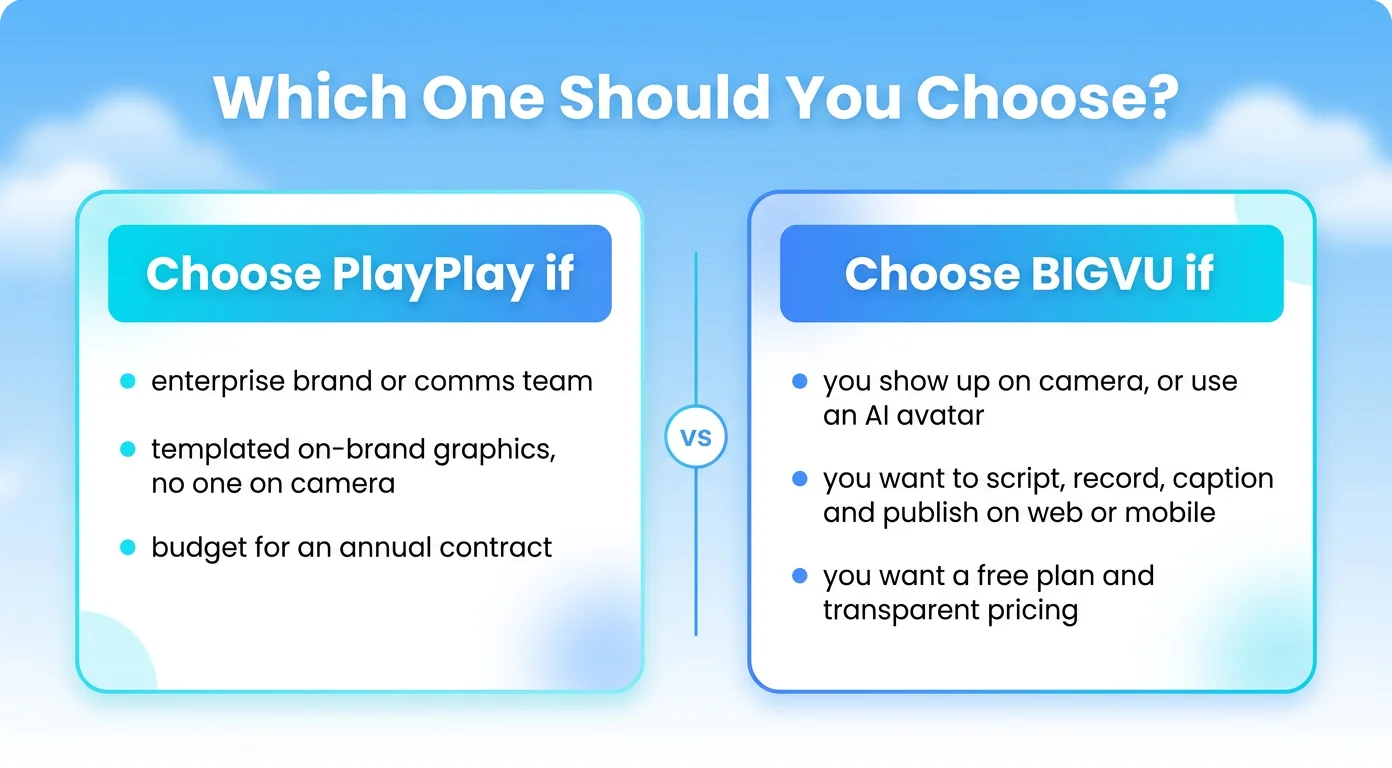
PlayPlay vs BIGVU: Which One Should You Choose in 2026?
Both are good tools. They are just built for different people, so the right choice comes down to who is making the video and what it is.
Choose PlayPlay if:
- You are a brand, marketing, or internal comms team at a mid-size or large company
- Your videos are templated, on-brand graphics and text, usually with no one on camera
- Brand consistency across many creators and a dedicated account manager matter more than self-serve speed
- You have budget for an annual enterprise contract
- You or your team need to show up on camera regularly, and want to look confident doing it
- You want to script, record, caption, brand, and publish social video on web or mobile
- You are camera-shy or never know what to say, and want the AI script plus teleprompter to carry you
- You want a free plan and transparent pricing, with no sales call to get started